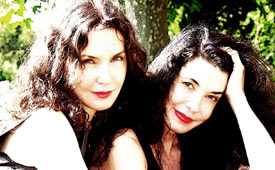
It’s no surprise that we’re lauding the praises – once again – of Katia and Marielle Labèque, the fabulous piano-playing duo that has been performing together for decades. (Click here for some of our past coverage.) Born in the Basque region of France and currently living in Rome and the South of France, the sisters recently appeared at the Hollywood Bowl (click here to read about that). This weekend they’re premiering a double piano concerto at Walt Disney Concert Hall.
Written for them by Richard Dubugnon, Battlefield, Op. 54, is a concerto for two pianos and double orchestra. Commissioned by the Los Angeles Philharmonic and conducted by Semyon Bychkov, Marielle’s husband, this piece promises to dazzle. And, to get things going, the Labèques are also going to perform Ravel’s Rapsodie espagnole (for two solo pianos), the concert concluding with Rachmaninoff’s Symphonic Dances.
Prior to the siblings’ Bowl performance, we sat down with them for KUSC-FM radio. Our conversation covered the musical waterfront – and then some – including the forming of their record company, KML Records, the secret to their career longevity and the state of concert dress today. Being devotees of haute couture, Katia and Marielle were vocal on the subject, and though they don’t know pianist Yuja Wang and the brouhaha she caused in her orange micro-mini dress (click here for more on that), they believe there is no double standard when it comes to onstage garb.
For those who missed the KUSC broadcast – or for those who would like to hear the Labèques again, in their own words – click here for the November 5 Arts Alive show. Then get a ticket for Disney Hall and hear for yourselves why Katia and Marielle Labèque are rock stars of the piano…and Madonna’s favorite keyboardists.
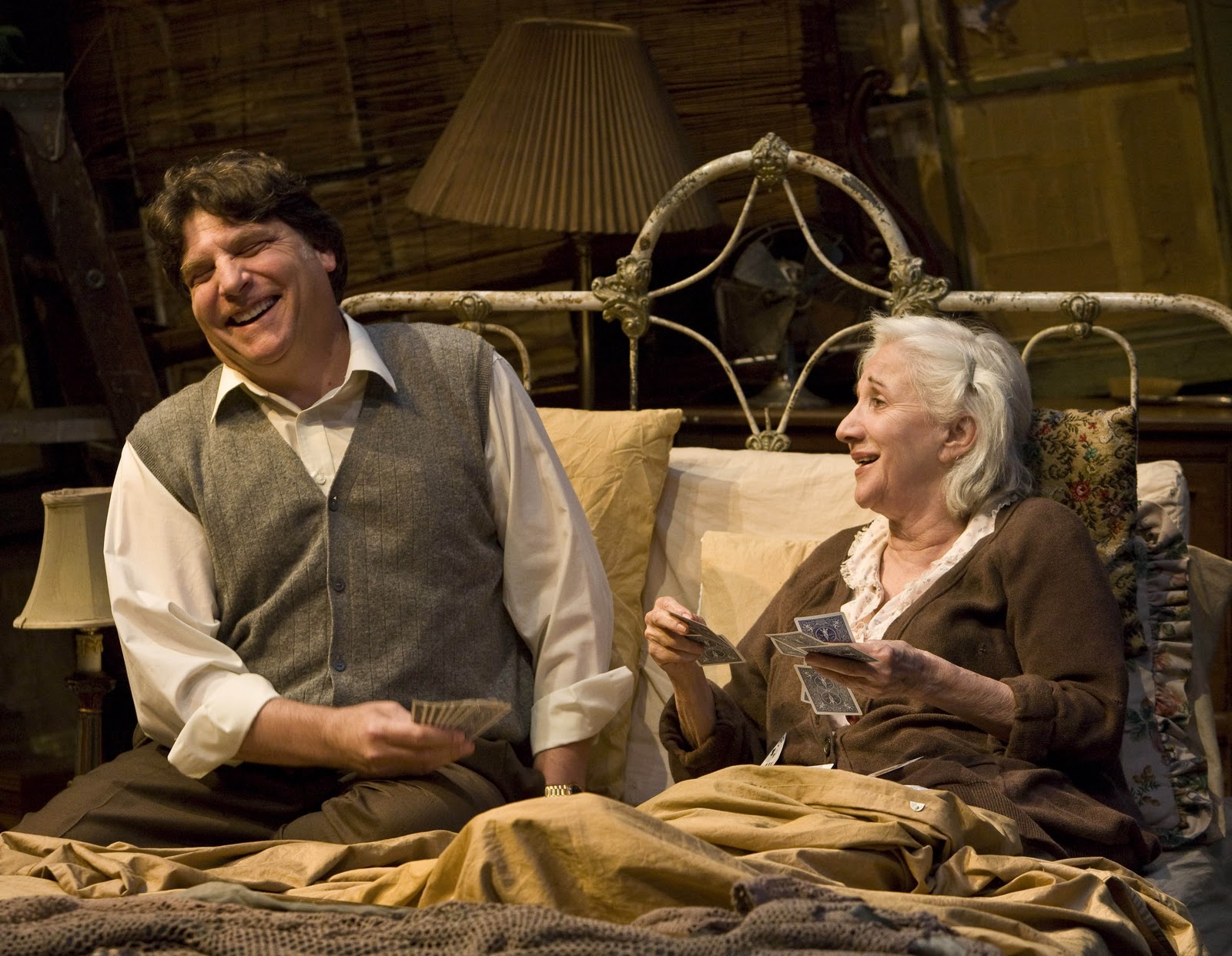
Although she’s only got about 12 lines in the two-character play, Vigil, Olympia Dukakis is riveting. Like a silent screen actress, she telegraphs an array of emotions – frustration, sadness, horror, glee, surprise – when listening, responding to and/or dealing with Kemp, a self-involved, middle-aged man played with panache by Marco Barricelli in Morris Panych’s two-act work (in photo below, by Craig Schwartz).
Onstage at the Mark Taper Forum through December 18, the play has Kemp turning up at Grace’s bedside –having not had any communication with her for 30 years – after receiving a letter that she’s dying. Full-blown gallows humor prevails, with deep ruminations on family, identity, and the human condition also center stage.
Dukakis, now 80, is acting gold. Sure, we want her to speak so we can hear that throaty, marvelous voice, but we’ll take her any way we can. And watching her prance about like Charlie Chaplin one moment, looking tipsy, albeit in bed, blowing a New Year’s Eve noisemaker the next, is an absolute delight. Barricelli, powering the show with mountains of dialogue, is also up to thespian snuff. Indeed, he and Dukakis have worked together numerous times (they did Vigil in San Francisco last year), and are the consummate odd couple, “volleying,” as the San Francisco Chronicle wrote, “like tennis masters.”
For those unfamiliar with Dukakis (could that even be possible?), she’s racked up numerous credits and awards, including winning an Oscar for Best Supporting Actress – at age 56 – in 1987 for Norman Jewison’s Moonstruck, playing Cher’s mother, Rose Castorini. (Cher snagged the gold statuette for Best Actress, while Olympia, upon copping the Oscar, gave a shout-out to her cousin, Michael Dukakis, in photo above, who was running for President that year.) She also had a fabulous turn as Clairee Belcher in Steel Magnolias, a 1989 film directed by Herb Ross that featured a stellar ensemble, including Julia Roberts (not our favorite, but, whaddya gonna do…), Dolly Parton, Sally Field and Shirley MacLaine. (Click here for more on the fabulous MacLaine, who receives the AFI Lifetime Achievement Award next June.)
Then there was Dukakis’ memorable portrayal of transsexual landlady, Anna Madrigal, in the TV miniseries, Tales of The City. Based on Armistead Maupin’s 1970’s newspaper serial, Tales debuted in 1993 and was followed by sequels in 1998 and 2001. One of Ms. Madrigal’s unforgettable lines, “I have no objection to anything,” could also define Dukakis’ feisty personality.
This year, 2011, has been a particularly fertile one for the octogenerian. In January she starred in Tennessee Williams’ 1963 play, The Milk Train Doesn’t Stop Here Anymore in an Off Broadway revival for the Roundabout Theater Company. She’s also got a Harold and Maude-like storyline with Zach Galifianakis on Bored To Death for three episodes this season, eps that are nothing less than hilariously brilliant.
With no plans to slow down, Dukakis is even going to Cypress in January to perform another play – in Greek, no less. We’re thrilled to have chatted with her about this and other aspects of her life and career for KUSC, 91.5. Click here to hear Dukakis, in her own words. And go see Vigil. You’ll laugh, you’ll cry – and you’ll also be privy to experiencing one of the great actors of our time. And, hey – Barricelli’s fantastic, too.
We don’t know when it’ll come, where, how and, in some cases, why. But death will come. And as far as age is concerned, that’s a relative thing. Twenty years ago, for example, 77 would have seemed old. Today, fuggedaboutit. Especially when it came to Gil Cates, a vibrant, energetic, huge presence whose life abruptly stopped in a UCLA parking lot when he allegedly succumbed to a heart attack (COD: natural causes, but Cates had undergone heart surgery last month). Oy! At least he didn’t collapse on the 405.
Seriously, since Cates was the founding dean of UCLA’s School of Theater, Film and Television, his expiring on campus almost seems okay, though it might have been more fitting if Gil had waited until opening night of the latest Geffen Playhouse offering, Next Fall, to take his leave. Why? Because he’d been the producing director of the Westside venue since its opening in 1995, which, btw, was named for media mogul David Geffen, no matter that Geffen was rarely, if ever, seen at his namesake house.
It wouldn’t have been the first time a thespian or thespian lover died in the theater. We remember when comic actor Dick Shawn (left), died onstage in 1987, during the second act of his wild and crazy performance at UC San Diego’s Mandeville Hall, leading audience members to believe it was part of the act. Cates, however, as show bizzy as they come, probably wouldn’t have wanted Geffen patrons to become so unhinged at having to witness such a final curtain (call).
But the man had a fabulous life and, in the process, he also made ours a little better: In a career spanning more than five decades, Cates worked on documentaries, episodic television, 14 Oscars’ productions (more than any other producer, bringing in hosting talents that included Billy Crystal – Cates won an Emmy for that show – Whoopi Goldberg, Chris Rock, Jon Stewart and Steve Martin). And speaking of Martin, the banjo-playing art collector tweeted his condolences Tuesday. “So sorry to hear Gil Cates has died. He helmed two Oscar shows I hosted. He was delightful, wise, canny and unperturbed. A great fellow.”
We like that adjective – unperturbed. After all, who else in Hollywood could be described as ‘unperturbed.’ Certainly not Joan Rivers, whose Joan Rivers: A Work in Progress by a Life in Progress was produced at the Geffen in 2008 (click here to read our take on that evening), after which it flopped both in London and New York. And of course, not even your scribe, who wrote the program notes for the Geffen for two seasons beginning in 2006, could be considered, ‘unperturbed.’
Sure, I may have been perturbed by life in general, but was never perturbed by Cates, as my notes were published nearly verbatim time and time again. Productions I wrote about included: Neil LaBute’s Fat Pig (Chris Pine, above, was nothing less than a revelation; he also went on to star with Chris Noth in Farragut North at the Geffen, which is now the basis for the George Clooney-helmed flick, The Ides of March…click here for our chat with Pine); Sam Shepard’s The God of Hell (directed by Jason Alexander, this was a raucous production); and Arthur Miller’s All My Sons, which featured fantastic performances by Len Cariou, Laurie Metcalf and Neil Patrick Harris (see below). I also had the dubious honor of being program annotator for Carrie Fisher‘s one-person extravaganza, Wishful Drinking, a work that successfully transitioned to Broadway and also became an HBO special. (We do wish she’d stop with those unfortunate Jenny Craig ads, though). In any case, they were great theater pieces all – and all were mounted under the aegis of the indomitable Gil Cates.
And though Gil was taken too soon and too swiftly, he left us with so much, and for that we are deliriously grateful. But, hey – since it’s not our job to write obituaries, click here to read the L.A. Times’ coverage, and click here to read a wonderful appreciation of Gil Cates by LA Times theater critic, Charles McNulty.
To show your appreciation for Gil Cates, then, don’t just read this: Go to the theater – any theater – from the Geffen and the Mark Taper Forum (stay tuned for our upcoming KUSC interview with Olympia Dukakis, who stars in The Vigil through December 18), to the Odyssey Theatre Ensemble (check out Justin Tanner‘s hilarious new play, Day Drinkers), and the tiny Skylight Theatre, which premiered John Fleck‘s glorious New York-bound show, Mad Women, L.A. is bursting with fantastic theater, large and small. And remember, when you’re sitting out there in the dark, listening and watching ordinary mortals doing extraordinary things – it’s called acting – you might actually believe that the world is filled with infinite possibilities.
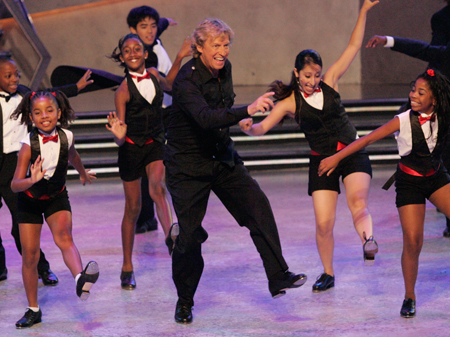
While we recover from our lightning fast trip to Parma (that’s Italy and the home of Parmesan cheese and culatello, not Ohio, home to the Buckeyes), we’re thrilled that the one and only Nigel Lythgoe recently received the Rolex Award at the Career Transitions for Dancers’ 26th annual Anniversary Jubilee. Hosted by Rolex Watch U.S.A., this year the event honors one of Britain’s most famous exports, Lythgoe, who is not only executive producer of the American Idol juggernaut, but also the creator, executive producer and resident judge of So You Think You Can Dance.
Lythgoe follows in the esteemed footsteps of erstwhile Rolex recipients that include Debbie Allen, Bebe Neuwirth, Ann Reinking, Twlya Tharp, and Patrick Swayze (in photo below with Jennifer Grey). Alas, since the event is being held at New York’s City Center, we shall not be there to personally congratulate the man himself.
But we did have the honor of interviewing Mr. Lythgoe for Dance Magazine, way back in 2007, so click here to read that story. Check out, as well, Dizzy Feet Foundation, the organization Lythgoe co-founded in 2009. Helping underprivileged young people realize their dreams of becoming professional dancers, Dizzy Feet also supports, improves and increases access to dance education in the United States, which, as we know, is no easy feet, er, feat.
But we digress: Those in attendance at the gala surely had a blast, as the event featured performances and a Masquerade Supper in the Hilton’s Grand Ballroom. (Note: If we were there, we’d have come dressed as the renovated Bolshoi Theatre – replete with stage, dressing rooms and performers – although Nikolay Tsiskaridze, below, panned the theater – click here to read that; and click here to read our 2006 Los Angeles Times story on the original Kings of Dance, including our interview with King Nikolay. Or perhaps we’d have been decked out as Anna Pavlova in her exquisite rendition of the Dying Swan. A ballet made for her in 1904 by Michel Fokine, it was the work that prompted Pavlova, in 1931 and on her Hague deathbed, to utter, “Bring me my Dying Swan costume.” Click here for our Dutch musings.)
In any case: Congratulations, Nigel. Long may your feet be dizzy, your energy unstoppable and your heart eternally open!
The nadir of thriller cop movies, The Son of No One reeks of wrongness, starting with the inane and meaningless title. It’s also got more annoying flashbacks than LSD guru Timothy Leary must have experienced during his entire lifetime. That said, writer/director Dito Montiel (we never heard of him before this, either…), has not only cranked out one of the worst films in recent memory, but he’s made some good actors look like neo-losers.
Dubbed in the press notes (where Montiel’s name is misspelled), “a searing police thriller” (to us, steaks are searing, police thrillers either cut it or they don’t – where are Antoine Fuqua and Training Day or Michael Mann and his brilliant Heat when you need them), the film revolves around Jonathan “Milk” White. A second-generation cop, he’s tacitly freaked out when he’s assigned to re-open a double homicide case from his old Queens neighborhood, a 16-year old cold case. Guess what? It was Johnny, himself, who was the murderer of the two skeeves, when he was but a wee boy. As an adult, Milk is played by an unwatchable Channing Tatum, who barely says 1,000 words during these 95 minutes of cinematic torture in which he acts like, well, an inert mime.
It’s no surprise then, that immediately following the murders Milk says nothing. He was also protected at the time by his father’s partner, a wizened Detective Stanford, played by the redoubtable Al Pacino. Wearing a wig that looks like a cross between Liberace and a Lucien Freud nude (don’t ask…but click here for our latest musings on the sequined pianist, including the upcoming Soderbergh-directed biopic), Pacino rasps his way through the flick. Meanwhile, a local reporter for a sleazy tabloid (Juliette Binoche is completely miscast as a disheveled Queens journo with the weirdest accent this side of Kazakhstan), has new information on the long-unsolved murders and goes about trying to get her scoop before she reaches a ridiculous end.
Hmm: What desperately needs scooping is the crap found on screen here. Indeed, in spite of the fact that we love, love, love Binoche and her risk-taking bent, there’s no hope for her in this film. From Louis Malle’s Damage with Jeremy Irons and her understated Oscar-winning performance in The English Patient, she’s always been stellar. Two years ago she even performed and toured with Kathak dancer Akram Khan in a duet he choreographed. (See video below.)
But we digress, as there’s even more onscreen lunacy contributing to this film being forgettable. How about the whining, plasticized presence of Katie Holmes, Johnny-boy’s wife and mother of their 5-year old seizure-prone daughter, a character who never has a seizure and has nothing to do with the plot. Then there’s Ray Liotta (below), as Johnny’s boss, Captain Mathers (a bit bloated, the dude can still act – calling Henry Hill! Too bad his efforts here are for naught). Finally, in the thankless role of a brain-damaged witness to the long-ago crime, a grown-up Tracy Morgan plays against type in a maudlin, mercilessly unfunny performance.
Montiel has no sense of storytelling, pacing or feel for any kind of reality. He also piles on so much melodramatic music (David Wittman and Jonathan Elias), that we feel as if we’re punch-drunk on a ferris wheel traveling in über-slow motion. But we marvel at the fact that Binoche, Pacino and Liotta would stoop lower than any Queens’ gutter to make such a film. Then we remember it must be for the money, although it doesn’t look as if Montiel had much of a budget. Stranger things have happened in Hollywood and there certainly have been worse movies. Too bad we can’t think of any just now. To quote Pacino, who has the best lines and tackles the thespian thing with his usual off-the-charts brio, “A man has to learn to live with shit.”
True dat, but must we live with it, too?
Outré in all respects (but fabulous, nonetheless), this Lucian Freud nude, by dint of its “de trop” factor, reminds us of Pacino’s wig in The Son of No One.
Oh: We’d be remiss if we didn’t add Margin Call to our current list of non-thrilling “thriller” movies. Described in that film’s production notes as an “entangling thriller,” Margin Call is, like Monteil’s Son ofNo One, J.C. Chandor’s attempt at an auteur-wannabe’s foray into writing and directing. Chandor, too, assembled a formidable cast, but in the yawn-inducing process of crafting a non-plot – Occupy Wall Street‘s got more going for it – Chandor made Jeremy Irons, Kevin Spacey, Stanley Tucci, etal, look as if they were floundering in the Dead Sea. For once, it seems, we at The Report are on the same page as Rex Reed – and in total disagreement with The New Yorker’s David Denby. (Should we cancel our subscription to that sacrosanct mag, or just chalk it up to the fact that when we saw Margin Call we had just learned that Steve Jobs had died? Whatever…)
What Lindsay Lohan needs is some real art in her life. She should also serve her jail time – for real – and learn how the other 99.9% live (or at least how those who break the law exist behind bars). OK, now that we have that out of the way (and don’t get us started on the Michael Jackson trial), we can get on to the more serious business of celebrating dancer/choreographer/writer Agnes de Mille.
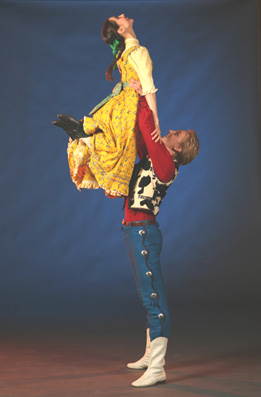
Nearly forgotten today, this formidable talent created countless works of art. In 1942, Rodeo (at left, Aggie, herself, and at top, ABT‘s Erica Cornejo and David Hallberg, the first American to join the storied Bolshoi Ballet), was a commission by the Ballet Russe de Monte Carlo. With a score by Aaron Copland, it received 22 curtain calls at its premiere and announced the arrival of a major choreographer. Rodeo is also probably de Mille’s most performed work. (Copland, on the other hand, would go on to collaborate with Martha Graham and win a Pulitzer Prize for his score for Graham’s Appalachian Spring two years later, his music a staple of orchestras worldwide.) But we digress: Rodeo was a kind of precursor to the ground-breaking de Mille choreographed musical, Oklahoma, one that would forever change the genre after its 1943 opening.
And while it’s a pity that more of de Mille’s works aren’t regularly revived (kudos, though, to Diana Beyer’s New York Theatre Ballet, a troupe that has helped keep the de Mille legacy alive – hello, Fall River Legend, de Mille’s 1948 terpsichorean telling of ax murderess Lizzie Borden), we now have a new collection of Aggie’s writings, Leaps in the Dark: Art and the World, edited by Mindy Aloff. Published by University Press of Florida, it’s an absolutely marvelous read.
De Mille (1905-1993), the daughter of screenwriter/director William deMille and niece of Cecil B. DeMille (yes, that CB – cue elephants and the parting of The Ten Commandments‘ Red Sea), was a brilliant artist with acute powers of observation. And although she published 11 books, a review of the London premiere of Balanchine’s 1929 Prodigal Son, and a monograph (Russian Journals), only her stellar biography of Martha Graham (1992), is, alas, still in print. (Click here for our coverage on the magnificent Martha.)
Happily, Aloff has assembled an intriguingly eclectic array of de Mille’s writings. They run the gamut from juicy portraits of her uncle “Ce” (the bit about Aggie choreographing his film, Cleopatra with Claudette Colbert, left, is priceless), ballerina superstars Anna Pavlova and Alicia Alonso (we had the pleasure of interviewing Dame Alonso at Havana’s International Ballet Festival; click here for more on the 90-year old diva), to exquisitely crafted essays and reviews. We also adored de Mille’s tale of Oklahoma’s development, not least of which was her first official meeting with librettist Oscar Hammerstein – by chance, she tells us – in a New York City drugstore.
Of course, Aggie began her career as a dancer, though her unconventional looks perhaps precluded her from landing more coveted roles. At right she can be seen as Venus in Antony Tudor‘s The Judgment of Paris (1938), photographed by the esteemed Carl Van Vechten. Among her many dance-making achievements, then, was choreographing 1945’s Broadway fare, Carousel, though not the film version, which featured New York City Ballet’s Jacques d’Amboise. (Click here to read our recent LA Times feature on d’Amboise; click here for our blog coverage of the erstwhile New York City Ballet star and founder of the National Dance Institute.)
Indeed, de Mille became one of the most in-demand choreographers in the country, with numerous concert works and a dozen Broadway musicals to her credit (1943’s One Touch of Venus, 1947’s Brigadoon and 1949’s Gentlemen Prefer Blondes, to name a few more). It was during that fertile period that then New York Times dance critic, John Martin, proclaimed the era the “de Millenium.” How cool is that!
What a triumverate! From left: Aggie, Martha Graham and Mary Martin
And talk about indefatigable: When she was 70, de Mille suffered a stroke that paralyzed her right side. But did she give up? No, she actually wrote five more books, including one charting her ailment, Reprieve. Providing extraordinarily detailed descriptions, Leapsin the Dark should be required reading for all serious dance students. In the book’s Preparing for Performance excerpt, de Mille wrote that a dancer must, “join forces with the waiting audience in high anticipation. You are out of yourself – larger and more potent, more beautiful. You are for minutes heroic. This is power. This is glory on earth. And it is yours nightly.”
All hail to Agnes de Mille: Goddess of dance and pristine purveyor of the written word.
Lindsay Lohan being taken away in handcuffs. If only she’d followed the path of a true artist – or at least did her community service in exchange for having lifted a necklace. Quel dommage!
There is nothing elementary about the one and only Emily Watson, whose 1996 mercurial film debut in Lars von Trier’s Breaking the Waves (for which she was Oscar-nominated) torpedoed her into the upper ranks of Hollywood (meanwhile, von Trier torpedoed himself at this year’s Cannes Festival with his pro-Nazi remarks…). Two years later Watson gave us another volcanic portrayal, that of real-life cellist Jacqueline du Pré, who was cut down in her prime with multiple sclerosis (and for which Watson received her second Oscar nod), in the three-hankie weeper, Hilary and Jackie. (And no, there were absolutely no references, hidden or otherwise, to then first lady Hillary Clinton and the former wife of JFK and Ari, Jackie Bouvier Kennedy Onassis.)
And while Watson seems to have a predilection for playing real-life people (she was Angela in Angela’s Ashes, the film adaptation of Frank McCourt’s Pulitzer Prize-winning memoir of the same name; and she assayed the role of Anne, Peter Sellers’ first wife in the HBO biopic, The Life and Death of Peter Sellers), Watson’s also made a host of narrative films. Hello, Gosford Park (helmed by the late great Robert Altman in 2001), Paul Thomas Anderson’s Punch-Drunk love (yes, opposite goofball Adam Sandler), and Red Dragon (ooh, beware Hannibal the “Cannibal” Lecter), the last two films from 2002.
In short, Emily Watson is one of the greatest actors of her – or any – generation. Statuesque (she’s 5’9″) and strikingly beautiful, with a malleable face and deep-set, piercing blue eyes, this gal cannot utter a false word, telegraph a wrong emotion or, indeed, do any onscreen wrong. (It’s the pictures that sometimes go wrong, cue Tim Robbins’ Cradle Will Rock…)
We also loved her in Synedoche, New York, Charlie Kaufman’s surreal tale of a struggling director played by the always fabulous Philip Seymour Hoffman, which was, admittedly, more of an ensemble piece and the last film we’d seen of hers way back in 2008. So it’s with extreme pleasure that we welcome Emily Watson back to leading lady status in another Oscar-worthy performance. The flick is Oranges and Sunshine, directed by Jim Loach (Ken’s son, in his feature debut, at left in photo), with Watson playing another real-life person (albeit one still alive), Margaret Humphreys. A Nottingham social worker, this courageous gal uncovered one of the most outrageous social scandals in recent times: the forced migration of children from the United Kingdom to Australia (some were sent to New Zealand and Rhodesia, as well, though this film deals only with the Outback “orphans”), a story she recounts in her book, Empty Cradles.
Watson, a mother of two small children, herself, gives a rich, profoundly moving performance of a woman who, almost single-handedly and against overwhelming odds, reunited thousands of families, brought authorities to account and drew worldwide attention to an extraordinary miscarriage of justice. What does it mean to lose one’s identity, to be high-jacked, as it were, from a living parent and shipped thousands of miles away to an alien land?
Ghastly and utterly unfathomable, it’s a story that nevertheless needs to be told. In Loach’s hands, it’s told deftly. Filming in both England and Australia, which Loach likened to shooting a “road movie,” the film is nothing fancy, but a beautifully treated emotional rendering of all involved, including masterful performances by Hugo Weaving and David Wenham (in photo below). As erstwhile child migrants, they, too, seek the help of Humphreys (at left), in locating their mothers, their families, their stolen pasts.
Formal apologies were issued in 2009 and 2010 by Australian Prime Minister Kevin Rudd and British Prime Minister Gordon Brown, respectively. But it’s not nearly enough – how could it be. And don’t even mention any kind of financial remuneration for the victims – it’s not there and won’t ever be. Instead, let us praise Humphreys, a modest, self-effacing woman, who is nothing less than a hero – something she doesn’t buy, however – maintaining only that she is, “doing her job.” Happily, she continues doing her job, and we thank her for this.
To hear our Classical KUSC chat with Watson, Loach and Humphreys click here. And check out Oranges and Sunshine, a movie that deserves our attention – and the attention of the world. This appalling act could never happen in today’s digital age, but the fact that it did, beginning in 1947 – and went on systematically for 25 years – is a blight on humanity, one that now, because of Humphreys, offers hope. Go see this astonishing film and then, please…call your mother!
When last we wrote about Eiko & Koma in March, they were in the midst of their retrospective tour, Regeneration (click here to read about the duo, their backgrounds, their work, the art of Butoh…). We also mentioned that this astonishing couple would be returning to Los Angeles to perform a piece commemorating the events of September 11 at the Skirball Cultural Center.
Well, better late than not at all. Here then are two video clips from that performance, Water, an achingly gorgeous, hour-long exploration of life, death, serenity and sadness, with music composed and performed by Robert Mirabal. (On one hand we wished no cameras had been allowed, on the other, we wouldn’t have been able to shoot any of this footage, albeit unedited and occasionally shaky. Whaddya gonna do?)
And while today is a holiday, Columbus Day, and banks and post offices are closed (but weirdly, not the stock market, which seems to have inexplicably shot up, while the Occupy Wall Street movement continues, and continues to spread, including publishing its own newpaper, the Occupied Wall Street Journal), we also have time to reflect. Indeed: We just finished listening to Leonard Bernstein’s Chichester Psalms and Mozart’s final work, his haunting and powerful Requiem, both performed by the Los Angeles Philharmonic at the Hollywood Bowl as part of the last concert broadcast of the 2011 season – the Bowl’s 90th – on Classical KUSC. (Click here for more on our lovefest with the Phil).
This emotionally charged music helps us mourn the passing of Steve Jobs (iGrieve, iSad, iRemember, iEtc.), an extraordinary visionary who left us way too soon, at age 56. And yes, it’s totally true, we are among the many millions who have an obsessive attachment to our Apple products: As we toil away on our iMacs, listening to the constant stream of chirps coming from our iPhones (in fact, we learned of Jobs’ death at an afternoon screening of the strictly mediocre film, Margin Call, after which everyone took out their cells to get more info), and iPads – the iPod is reserved for plane trips – we are forever grateful that Steve Jobs graced the planet with his presence, his genius and that uncanny gift he had of being able to give us what we didn’t know we wanted/needed until he, in fact, created it.
Thank you, Steve. You’ll be mightily missed but are forever with us – in our pockets, on our laps, in our ears, on our desks. And a million thanks to Eiko & Koma for sweeping us along with you on your many enlightening and healing journeys.
Oh, and while we’re at it: We’d like to thank you, dear readers, for bringing us into your digital lives every day. To quote Warren Beatty from Bonnie and Clyde, “Ain’t life grand!” And one final merci – an extra special shout-out to Warren’s sister, erstwhile hoofer and fabulous actor/writer/New Age diva, Shirley MacLaine, an Academy Award-winner who will receive the AFI Lifetime Achievement Award next June. Congratulations, Ms. Shirley, we love you madly!
Just a quick note from The Report, whose main scribe’s wild and crazy career has lately involved a lot of Bowl-going (some 25 times during the fabulous 2011 season), a bit of globe-hopping to cover music and dance festivals (click here for our LAT Dispatch From Amsterdam, here for Zürich and here for Montpellier), and a brief family visit to Florida to celebrate our birthday (which actually has something to do with our career, as it inspired us to begin writing a play, The Last Lobster in Lake Worth).
Having penned all of the program notes and broadcast scripts for the Los Angeles Philharmonic at the Hollywood Bowl, its 90th season – as well as interviewing many of the musicians heard during said broadcasts – we want to thank everyone for tuning in and remind you that the final broadcast airs tomorrow on Classical KUSC 91.5 at 2 p.m., as it has every Saturday for the past 10 weeks. The season ends on a solemn note, with Bramwell Tovey, Principal Guest Conductor of the Los Angeles Philharmonic at the Hollywood Bowl, leading the orchestra – and the Los Angeles Master Chorale (we wrote the program notes for the Chorale for four seasons) – in a concert of emotionally reflective music. And if you miss the program, you can hear it on the station’s website, KUSC.org, anytime over the course of the coming week. Oh, and one more thing: We want to give a very special shout-out and thank you to the amazing Brian Lauritzen, host of the program series and our editor extraordinaire.
So: With Leonard Bernstein’s Chichester Psalms and Mozart’s last work, his Requiem, programmed to commemorate the 10-year anniversary of September 11th (the concert was performed live on September 13), it was meant to provide solace. And so it did (click here for our 9/11 remembrances). For that is one of the many glorious reasons we continually turn to classical music – it comforts, inspires, enlightens, heals and provides an eternal source of awe – which is precisely what the Los Angeles Philharmonic provided for us at the Hollywood Bowl this past season.
Here, then, are some highlights from the past summer: Kicking things off, of course, was LA Phil Music Director, Gustavo Dudamel, aka, The Dude, in a series of wide-ranging programs that included Lang Lang playing Prokofiev (click here for our take on that), Turandot, and an all-Mozart evening (click here for our musings on the Shaham/Dudamel pairing). Other conductors also took the reins and unleashed joyful and powerful sounds, as well. From newly appointed Resident Conductor of the LA Phil, Lionel Bringuier (he only just turned 25), and superstar violinist Joshua Bell leading the orchestra for the first time in Vivaldi’s Four Seasons, to the beloved 78-year old maestro, Raphael Frühbeck de Burgos, it was certainly the best of times. We also adored hearing our favorite sibling pianists –Katia & Marielle Labèque (click here for more on the sisters, including news of their upcoming November appearance at Disney Hall), and the list goes on.
Indeed, the Bowl is our most favorite place to go in LA in the summer – and we’ve been going there for years. It’s not only a bucolic venue and a cool place to hear music, but it brings people together in an incredible way. It’s also democratic, as a ticket can still be had for a buck.
Now that we’re into Autumn, things are already sizzling with the Phil at its winter home, Walt Disney Concert Hall. This season, The Dude’s third, promises to be stellar, including a Mahler cycle, three staged operas and numerous commissions and premieres, the most recent being Esteban Benzecry’s Rituales Amerindios, first heard with The Dude‘s other orchestra, the Gothenburg Symphony and given its U.S. premiere last weekend in L.A. For those unable to get to the Hall this weekend for an all-Mendelssohn concert, not to worry, the program will be broadcast to theaters nationwide on Sunday as part of the orchestra’s LA Phil Live series.
Wow, the good news just keeps coming: This week the Phil announced a Dudamel-inspired music education initiative with Bard College and the Longy School of Music. And…drum roll, please, The Dude was named musician of the year by Gramophone magazine. There’s never been so much music in our city as there is now. Take advantage of this, take it all in…and start your own lovefest. In other words: Pop a cork and raise a glass to the Los Angeles Philharmonic!
One of the new crop of choreographic ‘It’ boys – along with Alexei Ratmansky and Christopher Wheeldon – Sidi Larbi Cherkaoui, 35, is also a mensch. Thus were we honored to interview him last June, before a work he made for the Dutch National Ballet (as part of the always fabulous Holland Festival), premiered. (Click here for our LA Times Dispatch From Amsterdam.) Admittedly, we were jet-lagged and since holding the flash mic aloft is also no easy feat (it has a built-in computer chip and is très, très heavy), we just let Larbi, well, talk…and talk…and talk.
But with his intriguing background – born in Antwerp, Belgium to a Moroccan father and Flemish mother – and his being in demand around the world (click here to read our LA Times 2010 review of Cedar Lake Contemporary Ballet’s performance of Larbi’s Orbo Novo), his conversation careened from growing up being influenced by Pina Bausch, Renaissance paintings and the music videos of Prince and Janet Jackson, to still being in awe of singer/songwriter Kate Bush. Larbi has also collaborated with other dancer/choreographers, including the celebrated Akram Khan (in photo at right, from zero degrees), as well as being the subject of a documentary, Sutra, a dance work he made with the Shaolin monks. (Click here to read our story on Dance Camera West, which screened Sutra, as well as Mike Figgis’ raw, ravishing The Co(te)lette Film last June, then click here for more on Figgis.)
But we digress: While most of Larbi’s musings have been relegated to The Report’s archives, our edited conversation is still sure to stimulate: Since Larbi formed a dance/theater troupe last year, Eastman – a literal translation of his last name, Cherkaoui, which in Arabic means “the man coming from the east” – we wanted to highlight the troupe’s visit to the Irvine Barclay Theatre this month. Hence, our KUSC chat is primarily centered around the Barclay engagement and Eastman’s West Coast premiere of Babel. The third part of a trilogy, the Guardian of London described Babel as, “The most fiercely resonant dance theater of the decade.”
Click here for our KUSC interview and then head to the Barclay 10/15 to experience Eastman’s Babel in the flesh. Alas: Larbi, he of the über-elastic body and silky limbs, will not be performing. But 13 dancers will, along with five live taiko drummers and singers, whose lyrical Indian tunes and Arabic laments promise to bring it all home.