The gal with the non-dragon tattoo – but she does have a pierced nostril – rocks. Proving we’re serious straddlers of high and low culture, we interviewed Glee’s super-talented assistant choreographer, Brooke Lipton, for a Dance Teacher Magazine cover story. And what a joy and privilege it was! Talk about an endless supply of energy: In addition to Lipton’s full-time gig on Fox, she teaches at conventions all over the country (below at The Pulse On Tour), further spreading the gospel of dance. On top of that, she’s a loving wife and mother of two.
Find out how the multi-tasking Lipton got her professional start at age 12, dancing at a pediatric AIDS benefit headlined by Paula Abdul, along with a very young Brian Friedman (a major dancer/choreographer in his own right, as well as the consulting producer of Simon Cowell’s U.S. version of The X Factor, Friedman was also the subject of a Dance Teacher Mag; click here to read that).
Lipton eventually went on to tour with such single-monikered chicks such as Britney (see below), Madonna (whose favorite pianists are the Labèque Sisters – click here to read our recent coverage of Katia and Marielle – that’s the high art stuff), Beyoncé (and no, we’re not gonna get into the Beyoncé dust-up re “appropriating” some of Anne Teresa De Keersmaeker‘s work, though you can see for yourself in the excerpt below), and Janet Jackson.
Click here, then, to find out how the 32-year old Brooke Lipton is an inspiration to those in the dance world – and beyond.
Posted inUncategorized|Comments Off on Glee’s Brooke Lipton: Dance on Fire
One reason for its success was that the four-actors-in-a-room stage scenario were so in synch it was like listening to a Bach fugue or a late Beethoven string quartet. We also dug the smart writing! But let’s face it, this comedy of ill manners, mordant and hilarious as it is in the theater, doesn’t become anything more when filmed, even if it’s done with panache by the one and only Roman Polanski (Repulsion, Knife in the Water, Chinatown, etc., and seen above in jovial mode, carried by the cast of Carnage).
In fact, it becomes less.
Here’s the skinny: Two married couples meet to sort out a playground fight between their 11-year old sons. The premise is simple enough – and so is the execution. The question is why a film and why Polanski? For one thing, he’s friends with playwright Reza. For another, he has a neo-gothic way with psychologically confining spaces/apartments (hello, Rosemary’s Baby, with Mia Farrow, above).
It’s also true that some of the greatest plays do become great films: The above mentioned Pulitzer Prize winning Edward Albee/Taylor/Burton Woolf flick (directed by Mike Nichols in 1966, it was his first film outing); nearly anything by Tennessee Williams (with special kudos to Streetcar Named Desire, starring Marlon Brando and Vivien Leigh, left); while even some very good plays transfer well to the cinematic medium, such as John Guare’s Six Degrees of Separation, John Patrick Shanley’s Doubt, and…well, we’re momentarily in brain freeze, so back to the toothless film that is now Carnage.
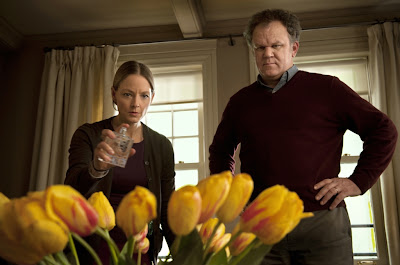
Surprisingly, the quartet of onscreen helicopter parents has one very sour note: Jodie Foster’s shrieking, histrionic Penelope. Unfortunately, the two-time Oscar winner is not aging well (at least not under Pawel Edelman’s photography), and after seeing Harden’s Tony-award winning portrayal of the bleeding-heart-Francis Bacon-loving frustrated writer (dubbed Veronica in the play), albeit one with a silky voice even when screaming and beating up on her hubby (onstage’s James Gandolfini), Foster strikes out.
And for some reason, Foster’s character, instead of making a to-die-for clafoutis (seen and eaten in the play), has now baked a boring cobbler. Small stuff, but clafoutis sounds funnier, and it’s a pastry Roman must know, being married to a French femme and all. (At left, the playwright in Venice for Carnage‘s opening in August. Not a bad life!)
As for the rest of the cast it’s quite up to thespian snuff. Kate Winslet, a type A investment broker, can vomit with the best of them, John C. Reilly is a requisitely shlubby salesman type, and Christoph Waltz, well, he can do no wrong. What took Hollywood so long to make use of this Academy Award-winning actor? (We loved his Nazi Col. Hans Landa in Quentin Tarantino’s Inglourious Basterds.) Waltz, constantly on his cell phone as a corporate attorney barking out instructions to simpering clients, looks swell and, with his rich, authoritative voice, also has impeccable delivery. And talk about his American accent – like Winslet’s – it’s note-perfect. Face it: The guy’s got gravitas, even when tossing off some of the film’s funniest lines and blow-drying his barfed-on pants (above).
A mere 80 minutes (the play was 90), Carnage seems like an exercise in confinement without a big payoff. Has Polanski, in his dotage (he’s now 78), become too cuddly? We don’t know what’s next for him (no trip to the States, that’s for sure), but do hope that he returns to form in the near future.
In the interim, Carnage will work just fine on your flat-screens – especially if you haven’t seen the play. But bring your own clafoutis!
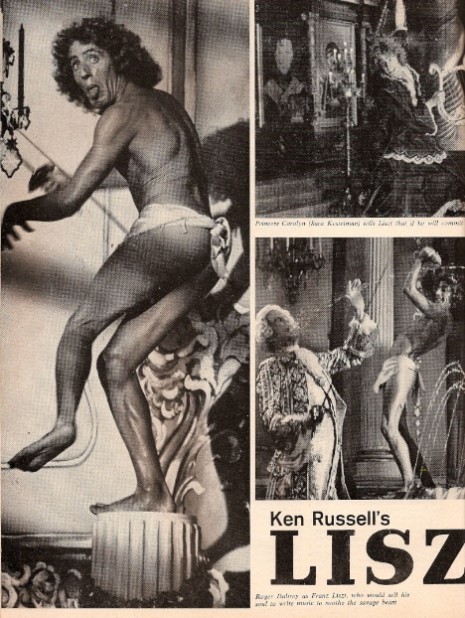
He was an incurable rabble-rouser, er, Romantic. Why else would Ken Russell, who died this week at home in England, at 84, make so many movies about artists and the creative process? His ability to make high culture for the masses was way ahead of its time, with films such as 1970’s The Music Lovers (about Tchaikovsky), 1974’s Mahler and 1975’s Lisztomania, with Roger Daltrey as Franz Liszt and Ringo Starr as the pope, were precursors to music videos and mash-up scenarios, aural, visual and otherwise. Then there’s the acid-infused Russell film, Tommy, based on the Who’s concept album/rock opera, also from 1975 (below, with Ann-Margret, etal), that did much to blow minds.
It took one to blow one, so to speak. How, then, did his come to be?
A lonely child and son of a shoe-store owner, Russell spent much time at the movies. He also staved off major bullying incidents while at school by mounting amateur productions of – not Fred & Ginger musicals – but those of Dorothy Lamour (at right). Russell could have been headed for major dragdom, but he married four times and fathered eight children (though he still could have preferred sarongs to suits).
After brief stints in the Merchant Navy and Royal Air Force, Russell moved to London where he, yes, studied dance, then photography, the latter pointing the way towards filmmaking. It was his love of dance, music and art that led him to make numerous documentaries at the BBC, where he began working in 1959. Subjects included such disparate composers as Elgar, Prokoviev and Debussy, the painter Henri Rousseau and the grandmother of modern dance, Isadora Duncan. (Below, Vivian Pickles in Isadora, The Biggest Dancer in the World.)
Outré is as outré does, and Russell had eccentricity in spades. His breakthrough film, Women in Love, a 1969 adaptation of the D.H. Lawrence novel, actually featured an extended nude wrestling scene between Alan Bates and Oliver Reed. Glorious! It also earned Russell his one Oscar nomination for best director, with Glenda Jackson snagging the gold statuette for best actress.
We adored Russell’s homage to 30’s musicals, The Boy Friend (1971), with Twiggy and Tommy Tune (below); and his hiring ballet superstar, Rudolf Nureyev, to play the lead in 1977’s Valentino, the silent screen star, was an inspired bit of casting. (At right, with Michelle Phillips)
If he seemed obsessed with composers and sex, authors and sex, devils and sex, and whatever and sex, well, why not. His philosophy was “critics be damned,” including Pauline Kael, who once called him a “shrill, screaming gossip.” Then there was the recent Joseph Lanza biography, Phallic Frenzy, in which the author gives his subject a massive drubbing. Bah! We love the notion that Russell stayed true to his vision, however oblique, twisted, dark, musical, dancerly or outright blasphemous (hello, The Devils). We also marvel that he wrote six novels, including Beethoven Confidential and the deliciously titled, Brahms Gets Laid.
Put us on an island, please, with Ken Russell’s complete oeuvre – his short films, docs, feature films, columns, books and the like, though we would need some Bach thrown in for good measure, particularly Glenn Gould’s recording of The Goldberg Variations. Now that would be a long, strange trip…and we’d never be bored!
They just don’t make ‘em like Aung San Suu Kyi anymore. Winner of the Nobel Peace Prize in 1991, the woman with the nearly unpronounceable name was the young daughter of a Burmese general who was murdered in 1947, an act that eventually led to the military takeover of that country. Suu Kyi left Burma (known as Myanmar since 1989) to attend Oxford, where she met and married Michael Aris. The couple had two sons, lively academic careers and a wonderful life, when, in 1988, Suu Kyi returned to Burma. Once there she led her National League of Democracy to victory in a 1990 election, only to be placed under house arrest for – gasp – nearly two decades by the country’s brutal military regime.
Directed by Luc Besson (La Femme Nikita, The Professional), The Lady is an epic love story – between a man and woman and between a woman and her country. Written by Rebecca Frayn and sumptuously shot (in Thailand) by Thierry Arbogast, it stars a brilliant Michelle Yeoh (Crouching Tiger, Hidden Dragon), in the title role, one for which the Malaysian actor had to learn Burmese. The Lady is also anchored by co-star David Thewlis as Aris, a scholar and Asian specialist. (Eminently watchable, Thewlis has been in dozens of films, although we’ve never seen a single Harry Potter flick, but did love him in 1993’s Naked. And he certainly held his own with Brad Pitt in 1997’s Seven Years in Tibet, not to mention cutting up in The Big Lebowski.) In The Lady, Thewlis, doing double duty as Aris’ twin brother, displays an astonishing emotional range that balances the calm of Suu Kyi.
While his wife was held captive in her homeland, Aris was lovingly raising the couple’s sons back in England (cue violins – seriously, composer Eric Serra’s sweeping score hits all the right notes), at the same time he was working to raise worldwide awareness of his wife’s unrelenting fight for democracy. Indeed, Suu Kyi was only released from house arrest last year; Aris, meanwhile, died from prostate cancer in 1999, not having seen his wife for several years before his death, as Myanmar authorities wouldn’t grant him a visa. As for the dissident, Suu Kyi, she was left in the untenable position of having to choose between her family…or her country.
Bring your hankies, as the kind of courage, devotion and determination exhibited by Aung San Suu Kyi are rarely seen in today’s world. To know that a person like Suu Kyi lives and walks among us seems to keep hope, somehow, alive. Thank you, Luc Besson, for bringing this inspiring story to the screen. Would that we take a cue from the lady rarely seen without flowers in her hair.
Director Luc Besson on the set of The Lady, based on the life of Nobel Peace Prize winner, Aung San Suu Kyi
P.S. Timing is everything and this week Secretary of State Hillary Clinton forayed to Myanmar, the first by any secretary of state since 1955. Her visit included several meetings with the most lauded dissident since Nelson Mandela, Aung San Suu Kyi. We love the photos of this historic occasion. In November, 2012, re-elected President Obama, also visits Myanmar (at top). Peace!
Joan Didion, we feel your pain. And it is searing, as losing a child always is. Mercifully, though, Didion’s latest book on grief and loss, Blue Nights (Alfred A. Knopf), is short, because it’s doubtful we could emotionally handle a War and Peace-sized tome about this gifted writer’s pain, universal as it is. (Didion has, after all, been called a “connoisseur of catastrophe,” most recently by author John Banville in his New York Times review of the book.)
Lately, though, Didion’s pain has become a cottage industry. After the sudden death of her husband, John Gregory Dunne (he had a heart attack at the end of 2003), the writer poured her grief into an astonishing memoir, The Year of Magical Thinking. Published in 2005 (also by Knopf), the international bestseller went on to win a National Book Award. (So, too, did Patti Smith last year for Just Kids, click here to read our take on that). Thinking then morphed into a one-person Broadway play starring Vanessa Redgrave as Didion (above, with the author), running for some 144 performances in 2007. But between Dunne’s death and the Broadway show, the couple’s 39-year old adopted daughter, Quintana Roo, died in 2005 from acute pancreatitis.
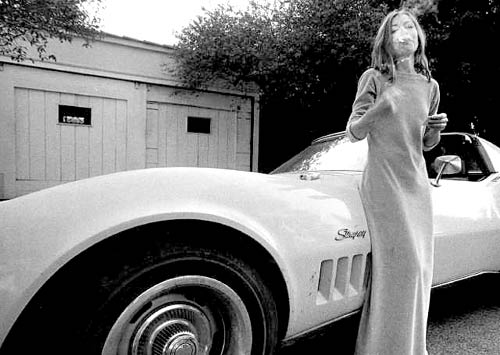
What are we to glean from these works, notably Blue, in which the author makes use of a bare bones, declarative structure and speaks directly to the reader? Moving back and forth in time, including chronicling the family’s early days in starry Malibu (above), Dunne’s death and the devastating loss of Quintana, the book is also a treatise on aging, albeit aging with and around privilege. As Didion and Dunne were both multi-talented writers, including penning screenplays (among them: The Panic in Needle Park – Yo, Al Pacino [for our take on Al’s most recent movie, The Son of No One, click here]; Play It As It Lays; and A Star is Born, the 1976 version with Stresiand and Kristofferson), Didion talks about taking Quintana with them on shoots, to hotel rooms, to places far from the madding crowd, so to speak, unless you call the Hollywood crowd madding, which, when you think about it, it surely is, leaving them in the thick of things.
Ah, the peripatetic life. Their life. A unit. A Family. In truth, a celebrity family, even though writers are generally considered the low peeps on a Tinseltown totem pole. But consider this: We learn that Quintana Roo, immediately after being adopted, was taken from the downtown L.A. courthouse to lunch at the Bistro in Beverly Hills.
And one of her christening dresses was a gift from Chanel-clad Connie Wald, the by-then widow of famous producer Jerry Wald (Mildred Pierce, Key Largo, the Cary Grant–Deborah Kerr love duo of An Affair to Remember are among his many flicks. An aside: We knew Connie Wald through the late Ivan Moffat – click here for our remembrances of him – whose best man at Moffat’s second wedding was Dominick Dunne, the late brother of John Gregory Dunne. The circle remains unbroken; six degrees of separation, though we understand that is now down to 4 and some change…).
But we digress: Designer labels, from Porthault (usually linens, in this case a parasol) and Christian Louboutin (the red-soled shoes Quintana wore at her wedding), to David Webb jewelry, accommodations at the Ritz and a Payard cake, are all sprinkled liberally throughout (as are the words “depression” and “fear”). Are we to think of these deluxe brands as some kind of catalyctic emotional deadeners, for this is a book about inconsolability? Or are we made to feel better about ourselves, as none of the talent, privilege and connections the Didion-Dunne family had/have, could ultimately spare them from tragedy.
In the end, though, nobody is spared from tragedy. It’s how we deal with it that matters. Didion deals with it in words, some of which include “maintaining momentum,” her notion of keeping going (book tours and the like), even at the cost of declining health. And then there is her unique view of, well, the past: “Memories are what you no longer want to remember,” she writes.
This is tough stuff for some to reconcile; others might become frustrated with her highly stylized approach to life and death. Be that as it may, Blue Nights, in the end not as stunning or piercing as Magical Thinking, can be, if not a cuddly companion on a chilly evening when one wants to muck about in the morass of the inevitable – can be more like spending a bit of quality time with a singular mind. For Joan Didion, now frail and admitting that writing “no longer comes easily to me,” is always worth reading. Indeed, we’re sorry for your loss, Joan, but however slight or skewed the writing comes, we’re still grateful it does.
To further your Didion experience, why not revisit some of her earlier works, such as the non-fiction tome from 1968, Slouching Towards Bethlehem, or the fictional, A Book of Common Prayer, from 1977?
Whatever his method – indeed, methods – we love David Cronenberg. At least as a filmmaker, since his foray into opera with 2008’s The Fly (LA Opera), was a swat-worthy misfire. His latest flick, A Dangerous Method (bad title, but whaddya gonna do), is based on a true story about Carl Jung (an Oscar-worthy performance by the eminent Michael Fassbender), a psychiatrist who takes on the case of an unbalanced, 18-year old Russian hysteric, Sabina Spielrein (a courageous Keira Knightley). Jung’s treatment is derived from his master, none other than the father of shrinkdom, Sigmund Freud (Viggo Mortensen, in a surprising performance that is sardonic, astute and cigar-chomping).
Let the games – and talk – begin.
Depicting a series of occurrences from 1907 to the eve of World War I, the film, written by Oscar-winner Christopher Hampton (Dangerous Liaisons), is based on his play, The Talking Cure, which actually stems from John Kerr’s book, A Most Dangerous Method. (Whew…) Chronicling the, er, maleable relationships of this doctor-patient triangle and sumptuously shot by Peter Suschitzky in Cologne and Vienna (the latter standing in for Zürich, a town we visited last summer – click here for our coverage of the Swiss burg), Method almost makes madness look enticing – or at least the after-effects of said condition, especially as portrayed by the anorexically gorgeous Knightley.
Enter analyst Otto Gross (the eternally intriguing Vincent Cassel, so good at being bad, even in Black Swan – click here for some of our BS coverage), who is sent to Jung by Freud to stir things up, id-wise. And since Otto is nothing if not pure id, sex rears its slithery head, causing ripples in Jung’s pristine marriage to the aristocratic Emma (Sarah Gadon). If it all sounds too Freudian, well, that’s because it is…hellooo!
Will Jung bed Sabina…in a boat? On the floor? Will Freud? What about the Oedipal thing between the two doctors? And what about Sabina and Freud being Jewish to Jung’s steely Protestant? Does sex hurt or help? Will Sabina become a therapist in her own right? Who’s snorting coke? Do we care? And how is Howard Shore’s music? (Hint: Here it works just fine.)
When these questions are tackled by someone of Cronenberg’s stature (we loved Dead Ringers, Naked Lunch, Eastern Promises, and the list goes on), we can’t help but care. Add Denise Cronenberg’s glorious period costumes to enhance the proceedings, and A Dangerous Method is an elegant and intellectual ride, intriguingly shot through with flashes of Cronenbergian dread. This head-trip of a film may be an acquired taste, but it’s one we’ll be savoring again.
From left: Michael Fassbender as Carl Jung and Viggo Mortensen as the fatherly Sigmund Freud.
Who knew a chair could be revolutionary? Charles and Ray Eames did. And no, they weren’t brothers, but a wildly talented married couple who brought modernism to the masses. Their motto, “the best for the least for the most” may have been a utopian ideal of mass production, but postwar homes were filled with the pair’s creations, starting with the curved plywood chair.
Now comes Eames: The Architect and the Painter, directed by Jason Cohn and Bill Jersey. For Eames-o-philes and for those merely interested in learning about a fascinating duo that continues to impact society, the film chronicles the Eames’ rise…and rise, warts and all. And it’s even narrated by James Franco (is there anything this actor/writer/student/erstwhile Oscar host can’t do – oh, yes, the hosting bit – click here for our take on that). As for the doc’s title, Charles was an architect who never practiced and Ray was a painter who, well, didn’t paint.
Put them together and their collaboration is unprecedented, with interview subjects attesting to the joy and whimsy they brought to a look that could frequently be stark and hard-edged. Beginning with a chair, Charles worked with architect Eero Saarinen to come up with a prototype in 1940. Having manufactured some 150,000 wooden splints during war-time (sounds odd, but it’s true, as design, you’ll learn from the film, is in absolutely everything), the moldable plywood seat was an instant hit.
Ray and Charles married in 1941, with their trajectory to golden couple including their Venice, CA workshop, which employees likened to an adult Disneyland. From making chairs and all manner of furniture, the couple also became known for their Case Study house perched on a Pacific Palisades’ hillside. It was there they gave dinner parties where a dessert might be precious, but not edible.
(To get another Eames fix, go immediately to LACMA and check out the current exhibition, California Design: 1930-1965. Running through June 3, 2012, the LACMA show is part of the gargantuan, Pacific Standard Time: Art In LA 1945-1980city-wide exhibition. Among the 350 fabulous items at LACMA, including a 1936 Airstream trailer to die for, is a re-creation of the Eames’ 1949 steel-framed house. The coolest part? It’s filled with the actual contents of their living room, including books, geegaws, tapestries, rugs, tables, tchotchkes and, of course, a sofa and chairs. Btw: We really dug the clothes, especially the Rudi Gernreich bathing suit – alas, not the topless one – and red knit dress.)
But we digress: The doc also includes short films the couple made for the U.S. government, IBM and Polaroid. It may have been ideas the pair thrived on, but that they actually managed to execute thousands of them, including mounting an exposition on Benjamin Franklin and Thomas Jefferson, a show that was text-driven and deemed a flop, is no less remarkable. Indeed, A.O. Scott of the New York Times draws parallels between the Eames’ design output and that of the late Steve Jobs (click here for the NYT review of the doc).
But, as was the case in the pre-feminist Mad Men-era, Charles received the design credits. And of course, he also had beaucoup de women on the side, marginalizing Ray even further. But they stayed together, with Charles dying in 1978 and Ray, ten years later to the day.
The filmmakers draw from a wonderful cache of archival material, including love letters, photos and artifacts produced in staggering numbers. There are also interviews with family members, including daughter Lucia and grandson Eames Demetrios, design historians, architects and notables such as filmmaker Paul Schrader (he wrote the Martin Scorsese-directed Taxi Driver), and TED founder Richard Saul Wurman. Staff members who worked with the couple during the über-creative 40-year epoch of the Eames Office also provide insight, with “charismatic” being one of the operative words for Charles. Finally, for anyone interested in design, its impact on society, and how we live with it, cherish it, rebuff it and connect with it in intriguing ways (shades of Jobs again and his Apple products), Eames: The Architect and the Painter, is a must-see.
The iconic Eames lounge chair and ottoman, which is de rigueur for every modernist. An original rosewood chair can be had for about $7,000., while the postage stamp, seen below, can be had for considerably less.
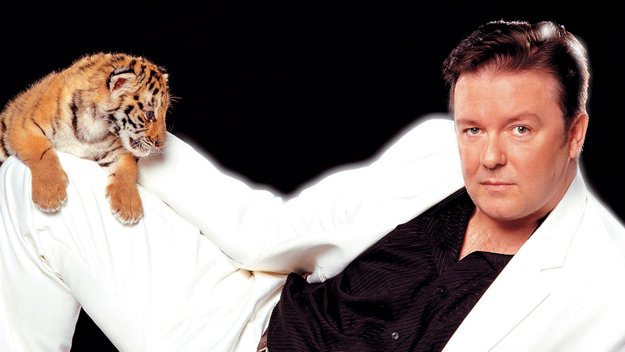
It’s no secret that we’re madly in love with Ricky Gervais (click here for our Oscar coverage, which slammed the show but touted the terrifically talented Mr. Gervais). And though we never watched The Office (either version, British or American), we have been huge fans of his HBO programming, namely Extras and The Ricky Gervais Show, the latter an animated laff riot also starring Gervais’ fabulous writing partner, Stephen Merchant, and their oddball foil, Karl Pilkington.
And now, not only is Gervais about to launch a new show, Life’s Too Short, an observational comedy that stars little person Warwick Davis (with appearances, natch, by Gervais, Merchant and a plethora of cool stars), it’s just been announced he’ll once again be hosting the Golden Globes. Wow! The Hollywood Foreign Press may be a small group of bad journalists always on the take, but they know how to deliver ratings: Bringing back Ricky to insult them and a slew of Hollywood superstars, including Charlie Sheen and Robert Downey Jr.(which he did at this year’s ceremony), is ingenious, cuz he’s got an insider/outsider viewpoint that is absolutely hilarious, as well as right-on.
And lest we forget, Ricky also made a memorable appearance this past season in Larry David‘s Curb Your Enthusiasm (below), making the dude, if we do say so ourselves, kinda peerless!
Yeah! We can hardly wait for January 15 at the Beverly Hilton Hotel. As for what’s gonna be vying for that mixed bag of prizes, we haven’t seen enough films yet to make any predictions (and don’t really watch much network TV). We’d love Emily Watson to get nominated for her emotionally wrenching portrayal of social worker Margaret Humphreys in Oranges and Sunshine (click here for our Classical KUSC chat with Watson, Humphreys and director Jim Loach), but we’re afraid the movie will get lost in the fray.
We did love David Cronenberg’s A Dangerous Method and believe that he’ll be nominated, along with the brilliant Michael Fassbender as Dr. Carl Jung and a glorious Keira Knightly as patient Sabina Spielrein. Ralph Fiennes (seen above with Gervais and Merchant, who wrote and directed the little-seen Cemetery Junction, which, btw, also featured Watson), makes a great directorial debut with Coriolanus. But the film, about a brutal war (what war isn’t?), is difficult. Still, Vanessa Redgrave should get a supporting actress nod.
We are also looking forward to George Clooney’s The Descendants (and haven’t yet seen The Ides of March, with Clooney and Ryan Gosling, based on a play we caught at the Geffen Playhouse, Farragut North – click here to read about that and the recent death of Gil Cates), Steven Spielberg’s War Horse (Watson’s in that, as well), and the sexual addiction flick Shame (also starring Fassbender).
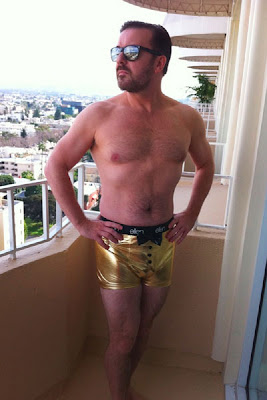
So, stay tuned for more from us on those end-of-year films – and whatever else strikes our fancy. But in the meantime, Ricky Rules, even in God-awful gold lame boxer shorts, tee hee!
As Jerry Seinfeld (or perhaps it was Elaine…), used to say, “One door closes and another opens.” It now seems that the Bolshoi Theatre, after a six-year, $700 million renovation, is like a revolving door for star dancers coming and going. David Hallberg recently made worldwide headlines when he became the first American to join the venerated Bolshoi Ballet (click here to read about that), while still retaining his principal status with American Ballet Theatre.
And what was meant to be the continuation of a glorious partnership with Natalia Osipova – the duo danced Giselle recently at the gala re-opening – shall be no more. Osipova and her other half, in life and in art, Ivan Vasiliev, announced plans to leave the Bolshoi for the Mikhailovsky Theatre, a smaller company in St. Petersburg now under the artistic direction of Nacho Duato (see below), effective immediately. (Osipova and Vasiliev were also frequent guest artists at ABT).
Ah, it seems like only yesterday (it was actually last year), when the ballet world received that jolt: Duato resigned from Compañía Nacional de Danza, the troupe he’d led for 20 years (click here to read our 2007 L.A. Times article previewing CND II’s appearance), and shortly thereafter, in another shocker, we learned that Duato would be helming the Mikhailovsky (he took the reins in January of this year). After all, how would the hot-blooded Mediterranean dancer/choreographer/director take to the freezing climes of Russia and a very different school of balletic thinking?
Obviously, with coups like recruiting Ivan and Natalia, Duato is adapting very well! We’re also proud to say that we knew Osipova and Vasiliev back in the day – or at least back in 2006, when we got to hang out with them at Havana’s International Ballet Festival. (Under the artistic direction of Alicia Alonso, this is one of the great pointe shoe festivals in the world – click here to read more about the nonagenarian who has no plans to disband her troupe, Ballet Nacional de Cuba.) But back to the Russians: When we met them a mere five years ago, they were soooo young – Ivan, 17, Natalia, 20 – but were already fire-breathing superstars. As their partnership deepened, so did their artistry.
And that’s what their move is about – “artistic freedom.” With the defection, the pair will not only have the chance to perform with other companies in addition to the Mikhailovsky, but will be able to broaden their repertories, which is what every great dancer wants to do – must do – in this YouTube era. (Click here to read our Dance Magazine coverage on Osipova’s role in the Bolshoi’s 2011 program, Reflections. We couldn’t get to the Kings of Dance concert this year, when Vasiliev participated, but click here for our Dance Mag coverage of last year’s concert and click here for our LA Times coverage of the original Kings in 2006.)
And for more on the latest Bolshoi defections, click here to read the New York Times coverage of this stunning bit of news. As we’ve been following the duo’s meteoric rise since Havana, we’ll be curious to see how this new move works out.
And speaking of moves – or ousters, as it were – it now seems that Miami City Ballet’s Edward Villella (seen in Balanchine‘s Prodigal Son, below), was not going to go gently into that good night, at least not of his own accord. Indeed, he’s being removed by the troupe’s board. Click here to read some of our Villella coverage, then click here to read about this latest balletic scandal du jour.
Whatever happens, though, ballet is big again, even without a Black Swan II on the horizon. (Thank god for that; but click here and here for some of our Natalie Portman, etal, coverage.) As for Nat’s and Ivan’s onstage coupling – their Romeo and Juliet is as good as it gets (click here for our Los Angeles Opera coverage of R & J) – the partnership just keeps getting better. And the offstage drama, in any case, continues…
Love conquers all – especially where bad sets and plebian direction are concerned. Such is the case with Los Angeles Opera’s current revival of its 2005 production, Roméo et Juliette, now at the Dorothy Chandler Pavilion through November 26. And though we’re going for the French pronunciation of Charles Gounod’s neo-clunky opera, directed by Ian Judge, it’s a multi-cultural affair, particularly with the young, hotshot Italian tenor, Vittorio Grigolo, making his LA Opera debut. (Having just returned from a quick trip to Parma, Italy, to cover some of the Verdi festival – and having eaten more ham than one should ever be allowed to – we know a thing or two about Italian tenors.)
But we digress: Nino Machaidze’s Juliette is not chopped liver herself (or ham, as it were), though during the second performance of this run, the slim, 34-year old tenor seemed to sing circles around his leading lady. Grigolo also cavorted, bounded about the stage with manic energy and did a series of serviceable pirouettes that would please Dancing With the Stars’ Bruno Tonioli.
Seriously, Machaidze, from the Republic of Georgia, has a rich, creamy voice and an intoxicating presence. No stranger to the City of Angels, the soprano made her LA Opera debut in 2009, in Donizetti’s L’Elisir d’Amore, and was seen earlier this year in the delicious Rossini farce, Il Turco in Italia (click here for our coverage of that). But in their many love duets – five, to be precise – she wasn’t always as sizzly as Grigolo. (Judge’s idea of a bedroom scene, with Juliette on the bottom and mostly out of sight, whereupon we ultimately discover that Roméo has been – gasp – naked, doesn’t help.)
Happily, Machaidze’s first act aria, Juliette’s Waltz Song, did register on the thrill-o-meter, her trills and embellishments requisitely shimmering. But comparisons are in order: In 2005, when the star-crossed couple was none other than Anna Netrebko and famed Mexican tenor, Rolando Villazón, sparks flew, though mainly from the then coveted throat of Villazón. (Alas, he blew out his voice and isn’t really singing any more – a real tragedy – but has appeared as a mentor on the European TV show, PopStartoOperaStar, where he was even seen dancing.)
However, even the above-mentioned couple had to contend with Mr. Judge’s problematic production. Beginning with John Gunter’s industrial-like set – movable cages with staircases that resemble a cross between downtown LA’s Twin Towers’ jail and Stomp! – are unattractive and clang when moved around. And while decked out for the ballroom scene with chandeliers and mirrors – choreography by Kitty McNamee – the set offers little room for any sort of minuet or pavane, though one could see the reflection of superstar Plácido Domingo, general director of LA Opera, conducting. That the maestro kept things moving at a crisp, steady pace is somewhat of a miracle, as the mega-tenor recently returned from a gaggle of engagements, including warbling in a pair of Covent Garden galas and opening a new opera house in Oman (somewhere in the Middle East, this reminds us of our coverage of a music and arts festival in Abu Dhabi; click here for that story). As for maestro Domingo, at the after-party for LA Opera’s season opener, Eugene Onegin – click here for our coverage of that – the tenor left at the stroke of midnight to catch a plane for China. How, we wanna know, does he do it?
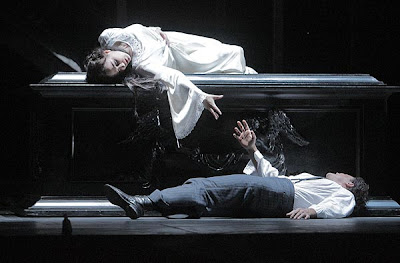
But back to the Shakespearean opus at hand: Some feral fight choreography (credit Ed Douglas), and fabulous singing from the chorus (Grant Gershon, associate conductor/chorus master, never fails to deliver; and since we wrote the program notes for four seasons for Gershon’s Los Angeles Master Chorale, we have first-hand knowledge of his many skills), helped things gel. As for the famous balcony scene – oy: Humongous bare branches hang from the rafters creating an Edward Scissorhands-like tableau, nearly eclipsing the pair before their sweet-sorrow parting. In the tomb finale, the business of dying – never easy – gives Grigolo and Machaidze ample time to stretch their golden cords one last time before expiring.
Other able cast members included: veteran Vladimir Chernov as a genial Lord Capulet; Ronnita Nicole Miller’s resonant nurse; and mezzo-soprano Renée Rapier, in an assured LA Opera debut as the invented-for-the-opera-character, Stephano, a Montague defender. No R & J can be complete without Friar Laurence, here sung by Vitalij Kowaljow, Tybalt (Alexey Sayapin) or Mercutio (Mueop Kim). Nigel Levings’ lighting design proved durable; Tim Goodchild’s costumes, for the most part, lush but not particularly inspired. (Call us crazy, but we still remember Gianni Versace’s luxe garb for a San Francisco Opera mounting of Strauss’ Capriccio with Kiri Te Kanawa. The year? 1990!)
That said, LA Opera’s Roméo et Juliette is still a fine way to spend three plus hours, as it did deliver the musical goods, especially with Grigolo, the youngest tenor ever to perform at La Scala (he was 23). First seen in our fair city warbling at the Miss Universe pageant in 2006, the tenor also released a single that year, with – of all peeps – the Pussycat Dolls’ Nicole Scherzinger. (Dubbed, You Are My Miracle, that’s a number we’re not sorry we missed). And not having heard Grigolo’s take on West Side Story, we can’t comment on his crossover prowess. We just know that he absolutely rocked the Pavilion as Roméo. And though we’re partial to Prokofiev’s 1935 ballet score (and dancers such as Rudolf Nureyev in photo above, with Dame Margot Fonteyn), but not Baz Luhrmann’s 1996 Romeo + Juliet, Claire Danes, who is fabulous in Showtime’s Homeland, notwithstanding), this opera, is still worth a listen/look.












 But back to the Shakespearean opus at hand: Some feral fight choreography (credit Ed Douglas), and fabulous singing from the chorus (