Welcome to 2012 and please forgive us for not having posted earlier in the new year, but we were felled by some mysterious stomach bug after a magnificent trip to San Francisco. That said, the short plane flights were perfect to catch up on our reading, specifically the latest from Julian Barnes. The Brit, who won the 2011 Man Booker Prize for The Sense of an Ending, a slim-as-prosciutto novella (it was his fourth nomination, his 11th novel), is a beautiful writer. But much as we liked this tiny tome of memory and missed opportunity from Alfred A. Knopf, we felt a bit like the protagonist, Tony, who, according to an erstwhile lover of his, “Never got it.”
Be that as it may, there is much to admire about the book, as well as much to ponder: Told from Tony’s point of view, a middle-aged man who’s had an amicable divorce, a daughter and very little stress throughout his life, our protagonist must finally deal with a past he’s virtually never considered.
So: If you’re looking for action, this book’s not for you, with Ending instead plumbing psychological and emotional depths, though Tony, breezing through four decades rather effortlessly, has been far from introspective. Indeed, to him, “memory equals events plus time.” And hey – if these bon mots sound vaguely reminiscent of a scene from Woody Allen’s brilliant Crimes and Misdemeanors, (with Alan Alda, below) – that “comedy istragedy plus time” – we’re not gonna quibble.
Seriously, what could be more subjective than memory, with the Rashomon principle generally the prevailing one, especially in an individual’s warped and ever-mutating brain.
(Oh: Speaking of the Booker and slim volumes, Philip Roth snagged the prize in 2010 for his equally slight manuscript, Nemesis, much to the dismay of feminist judge Carmen Callil. That whack job of a decider claimed that Roth, whose books don’t stint on sex – had any recently, Callil – didn’t deserve to be shortlisted, much less win the prestigious award. Oy! We worship at the altar of Roth, so click here for our coverage on America’s greatest living writer.)
But we digress: Coming of age in the 60’s, Tony was part of a male quartet whose golden boy, Adrian, seemed to have all the answers, or at least the pithiest classroom rejoinders. Herewith Adrian’s approach to the past: “History is that certainty produced at the point where the imperfections of memory meet the inadequacies of documentation.” Hmm. Adrian’s brilliance, of course – or his obliqueness – makes his suicide as a young man all the more puzzling. (And we’re still musing over Adrian’s musings, go figure!)
But it wasn’t the first suicide to take place in this British tale, and, all those years later, when Tony is bequeathed money by the late mother of Adrian’s girlfriend, Veronica (she had canoodled with Adrian after Tony was finished with her), Barnes’ prose then takes on an investigative quality. The book, wrote New York Times’ critic Michiko Kakutani, “manages to create genuine suspense as a sort of psychological detective story. We not only want to find out how Mr. Barnes’s narrator, Tony Webster, has rewritten his own history — and discover what actually happened some 40 years ago — but also understand why he has needed to do so.”
Circling back on itself, Ending practically demands a second reading, which is something we plan on doing after we’ve finished plowing through Steven Naifeh’s and Gregory White Smith’s fantastic new biography, Vincent Van Gogh: The Life, also from Knopf. And why not go back for more, seeing as we love all things Brits, save for the food, perhaps. (Click here then for our take on Ben Whishaw; here for Ricky Gervais; here for Keith Richards; and the list goes on, including our obsession with and addiction to…Downton Abbey, which we’ll be covering anon.
Reading Ending again will also slake our thirst for acquiring more insight into the human condition, something this book renders in a peculiarly exquisite fashion. So, bravo to Barnes on his Booker win (which comes with the tidy sum of circa $78,000.), and we promise we’ll let you know when we become less clueless and do finally, er, get it.
Before we get out of Dodge to ring in the New Year, we simply must say a few words about The Artist, though forgive us for coming somewhat late to the game. (And no, we cannot pronounce the name of the director, Michel Hazanavicius, below, who also wrote the endearing script, but we plan on learning how soon.) With six Golden Globe nominations to its credit, The Artist should fare well at the January 15 ceremony, especially as hosted by our fave bad boy of yucks, Ricky Gervais (click here for our coverage on that).
And speaking of awards, we are willing to stake our good name on this: The Artist, a magical valentine to the movies, mainly the silent screen era and the fickleness of fame, will win the Oscar for best picture. Why? Because it is glorious, inventive, heart-tugging, delicious and basically flawless. Oh, yes: and the Academy voters are mostly old-school. We also can’t think of another picture we adored as much. (Yes, we loved Terrence Malick’s Tree of Life – click here to read about that – but the critics have been divided. David Cronenberg’s A Dangerous Method – click here for that – is on our Top Ten list for this year, but the flick never really caught fire. We do hear that Scorcese’s Hugo is terrific – and will report on that anon – but for us, The Artist is pure bliss. Finally, it has the Weinstein Brothers behind it.)
As for brothers, it’s no surprise that Hazanavicius is French, following in the footsteps of those film pioneers, the Lumière Brothers, Auguste and Louis. (It was the frères who held their first private screening of projected motion pictures in 1895, in Lyon – click here for our coverage of that fabulous city, including our take on the Lyon Danse Biennale, one of the great festivals of the world). So why is this French film that, for all intensive purposes, is silent and shot in sumptuous black and white (cinematography by Guillaume Schiffman), all the rage?
For one thing, the actors, Jean Dujardin as quintessential movie star George Valentin, and Bérénice Bejo (the director’s partner, btw, below), playing aspiring thespian Peppy Miller, are absolutely splendid, their compelling faces indelibly lighting up the screen. His pomaded hair and pencil-thin mustache; her doe eyes and open smile (her legs aren’t too shabby either), all add up to one big spectacular shebang.
We also care about these people: He, who won’t recognize the coming of talkies, remains mute and eventually falls on hard times; she, all young, modern and exuberant, ascends to celluloid heaven in the Star-Is-Born vein.
Then there’s the notion that Hazanavicius is paying canny tribute to other classic films, including Citizen Kane, with Singin’ In the Rain also evoked, and some funky dancing integral to this story.
In truth, the film is not entirely silent. Indeed, there is an ebullient score by Ludovic Bource, replete with a perfectly placed quote from Vertigo (Bernard Herrmann’s memorable score from the Alfred Hitchcock masterpiece, with James Stewart and Kim Novak, right). There are also witty moments when several key sounds are heard, all adding to the originality of this work.
Of course, we must mention Uggie, a thoroughly winning Jack Russell terrier (the precocious, albeit hyper breed, is also seen to great effect in Mike Mills’ The Beginners, another very good film with Ewan McGregor and Christopher Plummer, the latter a seeming lock for Best Supporting actor). And speaking of supporting players, The Artist features fine performances by James Cromwell as a chauffeur, Penelope Ann Miller as Valentin’s downer of a wife and a pitch-perfect John Goodman in the role of blowhard studio head.
Much as Woody Allen’s Midnight in Paris is a delightful feel-good affair that we are also passionate about (and which will, no doubt, get well-deserved Oscar nods), The Artist makes something new from something old, breathing fresh life into our cynical high-tech digitized existences, all the while giving nostalgia a new twist and restoring our faith in films. The true artist here is Michel Hazanavicius: We salute you, monsieur.
It’s that time of year when we reflect: on life, love, loss, latkes and leftovers. As for us at The Report, we’ve been pondering Christopher Walken recently and would like to take a few moments to pay homage to one of our favorite actors, a thespian who also happens to be a superb song-and-dance man à la James Cagney. We should have scribbled something earlier this year after we’d seen Kill The Irishman, Jonathan Hensleigh’s film about Danny Green, the real life Irish thug who worked for the mob in – gasp – Cleveland, our home town, but Hensleigh missed the Mafioso boat and the flick fell flat.
Nevertheless: The era depicted was the late 70’s, with Ray Stephenson (Rome), playing Green, Walken as Alex “Shondor” Birns, and a host of others, including a bloated Val Kilmer, who was nearly unrecognizable, Vincent D’Onofrio, Paul Sorvino, etal. We wondered why the flick was shot in Detroit, standing in for the mean streets of Cleveland, though there were some recognizable elements. Indeed, what really flabbergasted us was actual news footage of the late Rabbi Rudolph Rosenthal, officiating at the funeral of Birns, a loan shark and nightclub owner. (The rabbi had been part of our family’s life for many years, through confirmations, bar mitzvahs, weddings and funerals, including that of our late brother.)
But we digress. Walken, who will be 69 in March and won a 1978 Oscar for best supporting actor in Michael Cimino’s masterpiece, The Deer Hunter, does crime guys exceedingly well, especially for director/wildman Abel Ferrara.
He ruled as a drug lord in Ferrara’s The King of New York (1990), and then as the oldest brother in The Funeral, from 1996, a Greek tragedy of a film we recently re-watched and which is what actually precipitated this post. Other stellar performances that come to mind include Chris’ turn in Pulp Fiction, which was nothing less than indelible, as was his maniacal brother portrayal in Annie Hall, from 1977. (Right: a shirtless Chris, just cuz he looked so gorgeous…)
Then came 1981, a big year for Chris. He was on the yacht, The Splendor, with Natalie Wood and Robert Wagner the night she died in the cold, cold waters off of Catalina Island. And seeing that this was the 30-year anniversary of Nat’s death, there was some brouhaha about reopening the investigation, a big whoop that went nowhere. (Chris and Nat had become friends while filming Brainstorm, above, Nat’s last film that eventually came out in 1983.)
In any case, back to 1981, when we were mad about the actor in Pennies From Heaven, not least because Chris’ dancing is to die for, with director Herb Ross making great use of the terpsichore’s tap skills. It’s only too bad that Chris couldn’t have done a Cagney/George M. Cohan-like leading man character (Cagney won the Oscar for Yankee Doodle Dandy), or a Footlight Parade kind of film in his dancing prime, though Pennies might serve as his Cagney/Shanghai Lil moment.
Ah, the years kept flying by, and in 2000 we were thrilled to have been able to see Chris live on Broadway in James Joyce’s The Dead, though when it came to the Ahmanson Theatre in Los Angeles it arrived, sadly, without him. In 2001, he again blew everybody’s mind: Chris Walken won an MTV Video Music Award for choreographing his own moves in Fat Boy Slim’s Weapon Of Choice.
Hey: There’s really not much that Chris can’t do, including playing John Travolta’s hubby in Hairspray, as well as being a regular presence hosting Saturday Night Live. Not only does he have a standing invitation for the gig (and has racked up nearly as many appearances as Alec Baldwin), he’s been wowing us with that wacky, wonderful pimp character, The Continental (left) on the show. And, in a non sequitur, we also love the notion that Chris is married to Georgianne Walken, casting person extraordinaire for The Sopranos (alas, they don’t have kids, cuz we would like nothing more than to have seen some little Walkens running around).
So, until somebody creates a film festival in this dude’s honor, we’ll take it upon ourselves to celebrate him. Here’s to the fantastic Christopher Walken: Long may you act, dance, live, laugh and sport your fabulous hair-dos. We worship at your altar and can’t wait to see what the coming year(s) will bring.
Talk about your major wardrobe malfunction: Thank you, Homeland, for sparing Sgt. Nicholas Brody (Damian Lewis, another amazing British actor with a killer American accent, above left and below), in your 90-minute season one finale. (Spoiler alert: Brody’s bespoke bomb vest, which would have taken down a bunker full of heavy hitters, including Jamey Sheridan’s Vice President William Walden, initially fails to detonate in the ex-Marine’s quivering fingers.)
As to how we feel about Claire Danes‘ C.I.A. officer Carrie Mathison, opting for electroshock therapy during the ep’s final moments, well, desperate actions call for desperate measures, and Carrie’s bi-polar affliction has been part of her brilliance. We only hope she doesn’t lose too much of her short term-memory in the long run, a cliffhanger, fersure, as just before getting zapped Carrie realizes something crucial to Brody’s having been turned into a terrorist.
Danes (left), in a word, is phenomenal, and not only because she studied modern dance, performing as recently as 2007 at New York’s P.S. 122, but because she’s fearless in showing raw emotion and dogged determination. In so doing, she helps to lead us through this twisty-turny, cat-and-mouse, post-9/11 psychological thriller, at the same time becoming part of a new golden era of television, one that rivets with its blood-and-guts/sweat-and-tears’ sensibility.
Completing the thespian trifecta is Mandy Patinkin, who, as Carrie’s C.I.A. boss and mentor, the wise, chicken soup-toting Saul Berenson, brings a bit of much-needed menschdom to the series, his own marital problems also coming in and out of focus. Patinkin, though he was George in Stephen Sondheim’s magnificent Sunday In the Park With George (his Dot was Bernadette Peters, both seen below in a tribute to Sondheim’s 80th birthday), hadn’t been our favorite onscreen presence in recent years, so it’s great to have him back in such a textured, yet tic-less role.
Then again, everyone on Homeland hits the right notes, from the gorgeous Morena Baccarin as Brody’s wife Jessica, to David Harewood as Saul’s superior, David Estes. (Another Brit, oy, this invasion could be cause for worry if we didn’t love these dudes so much. Btw, that would also include our going gaga for PBS Masterpiece’s recent Page Eight, David Hare’s take on modern-day espionage, which featured flawless performances by Bill Nighy, Ralph Fiennes and Michael Gambon, as well as BBC’s The Hour, starring Ben Whishaw and Dominic West – click here to read about those lads.)
Speaking of Hare (we loved his adaptation of The Reader), and writers in general, cuz if it ain’t on the page, it ain’t on the stage. And Homeland’s got writing to beat the Hail-To-The-Chief-band. Adapted from an Israeli TV series by Howard Gordon and Alex Gansa, Homeland takes us on a multifaceted journey where paranoia rules, tensions are sky-high and there are more cover-ups than those found on a pimply-faced teenager. Who else but but an outstanding scribe could conjure sniper Tom Walker (Chris Chalk), carjacking an old lady in order to fire bullets from her luxury condo (no Texas Book Depository here). Just another day – and another way – to breech security.
Should we be scared?
Oh, yeah, and we owe it to Showtime. With HBO’s Boardwalk Empire also just having finished an equally fabulous season (its second – click here to read our farewells to Michael Pitt’s Jimmy Darmody), we’re gonna have some pretty empty Sundays for a while. The good news is that Homeland is available On Demand, so we can go back to not only reveling in some of the show’s stellar moments (the trysting between Carrie and Brody in a parking lot was hot and turned out to have intended consequences…), but also to unravel stuff we may not have gotten the first time around. (Hey – we wouldn’t mind unraveling a bit of Brody!)
We’ll be watching the Golden Globes January 15 (click here for our Ricky Gervais update), rooting for Homeland for Best Television Series – Drama (Boardwalk killed Jimmy; they also won last year) and Danes and Lewis for Best Actress and Actor (though snubs for Patinkin and Pitt as Supporting Actors leave us cold). In any case, it’s almost time to light our Hannukah candles – and go see Tinker, Tailor, Soldier, Spy (Keith Olbermann raved about the flick with Gary Oldman in the Alec Guinness role originally written by John le Carré), to see how secret agents, moles and the like did it in the old days.
This just in: Congratulations to the incandescent Claire Danes for her Golden Globe award for best actress in a TV drama series; and to the show, itself, which won for best TV drama. Well-deserved and we couldn’t be happier, except that we wished Damian Lewis would have snagged a Globe for best actor (and don’t get us started on Kelsey Grammer, who robbed Mr. Lewis of the honor). In any case: Well done, Ms. D. and all the peeps involved in the show. Keep up the great work.
There are geniuses and then there are…geniuses. Einstein, Stravinsky and Steve Jobs come to mind. Then there’s Fela….as in Kuti, and Bill T. Jones.
Having been Jonesing – hahaha, all puns intended – to see Fela!, the high-octane Afrobeat musical based on the life and music of the Nigerian bandleader and political rebel known as Fela Anikulapo-Kuti, since it opened off-Broadway in 2008, and then when it moved to the Great White Way a year later, we’re happy to report that the show arrived with an end-of-the-year bang at Los Angeles’s Ahmanson Theatre. (Photos at top and above by Monique Carboni.) And it did not disappoint. (Having taken the place of a previously announced Funny Girl revival that already sounded like a disaster, what with shiksa Lauren Ambrose skedded to play the fabulously funny Jewess, Fanny Brice, immortalized on film by none other than Barbra Streisand, how could it?!)
And while we’re digressing, we also missed Fela! in Europe this past summer when we were in Amsterdam covering part of the Holland Festival, just not that part – click here for some of our reportage. That said, we were a tad disappointed, then, that Jones, one of our preeminent modern dance (and commercial) choreographers – he won Tony Awards for Spring Awakening and Fela! – did not make an appearance after the show’s rousing finale on opening night: We weren’t surprised, though, as we know how moody this brilliant provocateur can be; click here for our coverage of the 2010 Lyon Dance Biennale, which included the French premiere of Jones’ Fondly We Hope…Fervently Do We Pray (photo above). Jones had been in one of his famous snits, worried the French press wouldn’t like his Lincoln piece, and, indeed, one French critic we know proclaimed, “It was too American…too beautiful.” Oy! But the fact that he was working on Fondly and Fela circa the same time, wow…
Above: A video of Fela Kuti shot in 1971 by drummer Ginger Baker (he of the band Cream). A known junkie, Baker once made a fabled appearance on our now-defunct cable access TV show, The Looseleaf Report, with The Doors‘ drummer John Densmore. It was their first meeting, btw, and we hope to get the footage digitized in the not too distant future.
But back to the musical Fela! Conceived by Jones (right), Jim Lewis and Stephen Hendel, with a book by Lewis and Jones (is there anything Jones can’t do – besides show up at big-time openings?), the play lives and dies by its dance and music. Fela, who passed away in 1997 of AIDS, is astonishingly embodied by the Sierra Leonean multi-hyphenate, Sahr Ngaujah (five performances a week, until January 22). He not only has thespian and terpsichorean chops, but blows an absolutely wicked sax. As to his queens, his dancing queens, all eight of them (representing the 27 women Fela married), they are in a state of perpetual hip-swiveling, one that combines African moves and force-field energy kicks and struts, all finessed by Jones with staggering, well, grace. Hoo-wah! Talk about bootyliciousness.
Fela! begins on a fictitious night in 1978, shortly after the death of his beloved mother, the government-taunting Funmilayo, portrayed by a golden-throated Melanie Marshall. The setting is the Shrine, a Lagos, Nigerian nightclub where Fela ruled, with Marina Draghici’s eye-popping set and riotously colored costumes (she won the Tony for garb), all helping create an ebullient mood and fabulous backdrop to the African’s extraordinary sound.
And it’s a sound that Fela began cultivating in his London student days while listening to the likes of John Coltrane and Ol’ Blue Eyes himself, with James Brown also burrowing into Kuti’s musical DNA. It’s this sound that Kuti thought would – and could – revolutionize Africa. Moving back and forth in time, Fela! also includes Kuti’s California soujourn, notable for his having hooked up with a siren named Sandra (Paulette Ivory, below, photo by Raymond Hagans), a wild woman who introduces the musician to the writings of Marx (Karl, not Groucho), and tomes from the American black-power movement (hello, radical goddess Angela Davis, Malcolm X, etal.).
While this is a full-throttle production, including Peter Nigrini’s excellent video design, Robert Wierzel’s crack lighting and Robert Kaplowitz’ pitch-perfect sound design, its success lies in the near super-human talents of its performers. Included are the stellar tapper Gelan Lambert and Kuti’s fierce, on-stage band, led by conductor/trombonist/keyboardist Aaron Johnson. And while the violence that surrounded Kuti packs an emotional second-act wallop, the resultant overly long ghost-and-diety segment during which Fela visits his mother in an elaborate afterlife, could benefit from some judicious editing. (The show’s total running time is 2 hours and 45 minutes.)
With unrest continuing to roil the world and human struggles eternal, Fela! is no less au courant. Even Time Magazine weighed in, its Person of the Year, “The Protester” (designed by artist Shepard Fairey), speaking volumes .
As does Fela!, which makes you feel alive and grateful: To be in the theater; to experience bodies in delirious motion; to hear songs that will never die. Long live Fela!
Say it ain’t so, Terence Winter. Has the fabulous Mr. Darmody, AKA, Michael Pitt, really left your incredible HBO series, Boardwalk Empire, for that great TV heaven in the sky? (Wherever the hell that is, resting place of erstwhile Sopranos’ folk, including Big Pussy Bompensiero, Adriana La Cerva and Cousin Tony, played by Steve Buscemi, the only dude in recent memory to resurrect himself as a leading man, thank you very much, as the cutthroat but somehow endearing Enoch Thompson).
We are crushed. We are beside ourselves. We are in disbelief. Pitt, as far as we’re concerned, is the actor that Leonardo DiCaprio should have been. With more emotion in those steel blue eyes than the whole of Leo’s puffy, overly made-up body/face (J. Edgar does the erstwhile Titanic star no favors; click here for info on buying our out-of-print Leo bio, for as low as a whopping solitary cent), not to mention his enigmatic, always pensive look, as well as that perfectly tuned BE gimp walk of his, Pitt has been on our radar since Bertolucci’s The Dreamers, from 2003 (above). And as we recently returned from Parma, Italy, the director’s birthplace, we’ve also taken the opportunity to revisit that unsung film, swooning, we might add, ever since.
Then, of course, there was Pitt’s star turn as the Kurt Cobain-like stoner in another overlooked flick, Last Days (left). Directed by Gus Van Sant in 2005, the film featured Pitt as not just another pretty GVS boy, but one who could actually act, ultimately parlaying his fathomless depths into enticement and charm, even while portraying a zombie-like druggie.
Okay, enuf already with the superlatives, platitudes, plaudits. Excuse us, but we’re just really, really pissed off. Did we see it coming, after the surprising – and merciless – executions of Darmody’s wife, Angela (the always reliable Aleksa Palladino) and, gasp, her girlfriend, by Manny the Butcher Horvitz (a chilling William Forsythe who is a far cry from the phenomenal American born-choreographer of the same name living in Germany – click here for the terpsichore, seen below).
Perhaps. But did we honestly believe that Nucky could find it in his heart for some sort of forgiveness? And what about, er, redemption? Well, fuggedaboudit. After all, Boardwalk Empire is about revenge, a dish best served, if not always cold (something we don’t quite understand, as there may never be lukewarm revenge), then certainly steaming, as in the freshly-fired bullets of retribution/payback/settling of scores, which, when ya think about it, seems perpetual.
These past 12 or so Sundays have been both gratifying and anxiety-inducing, what with Homeland (another mind-boggling winner of a Showtime series that we’ll get to in a later post), rattling us to the core with its present tense tension and BE, taking us back to the roots of this country’s organized crime factions and the beginnings of terrorism, so to speak, the two shows butting up against each other in decidedly bi-polar, but gaga (and not the Lady ilk), i.e., awe-inspiring, ways.
We also love the notion that many of Boardwalk Empire’s cast and crew are Sopranos’ veterans. Hello, director Tim Van Patten, whom we met at the old Barbara Stanwyck/Robert Taylor manse when we were doing an LA Times article on the dance drama, the Ramayana (click here for that), and only rue the fact that at the time, 2004, we did not have HBO and thus didn’t fawn all over Mr. VP. For shame! (Admittedly, though, we much prefer La Stanwyck as the double-crossing vamp with Fred MacMurray in Billy Wilder‘s classic noir flick, Double Indemnity, below, than as Taylor’s wife, in name only, we understand, as she was a dyke.)
But we digress: Life is short. DVR this stuff while you can, then revisit the shows On Demand. (As we’re currently doing with The Wire, a series from 2002 that we originally couldn’t get into – perhaps the ghetto-speak was hard to grasp – and began to do so only after the Baltimore-based series wound down in 2008. We ended up full-blown Wire addicts, though, as it helped us recover from jet-lag after having returned from a trip to Italy; click here, then, for that piece, Debt In Venice.) Not to worry: We’ll also be getting to The Wire‘s phenomenal Dominic West in a future post. In the interim, click here to read our coverage on him and Ben Whishaw in The Hour, while Michael Kenneth Williams is doin’ himself proud going from The Wire‘s big bad Omar to BE’s bruising Chalky White.
Whew! And so, still in shock (and fighting off the remnants of yesterday’s evil migraine), we now have plenty of time to muse on BE’s Season Two closer. One of our thoughts is this: Why the killing off of Jimmy and not his mother, Gillian Darmody, for example, played in her singularly whiny, albeit still physically gorgeous way by Gretchen Mol, an actor we’ve not only met but can also say that we own one of her hand-beaded purses. (Big whoop and puhleeze, don’t ask…) Why didn’t Eli (Shea Whigham), Nucky’s half-wit of a brother get the gun-to-the-head arrivederci?
Why, indeed? And does this ending mean that it’s goodbye to incest? Was it all a bad dream? Or has Pitt moved on in order to make his mark on the big screen in a far bigger way than he has in the past. (We see no flicks for 2012 and beyond on his IMDB page.) Whatever it is, we are not, repeat, we are not thrilled. And Sunday nights will never be the same…until that is, next September rolls around.
Like Shostakovich’s 1932 satiric opera, Orango, which received its world premiere only last week at Walt Disney Concert Hall (click here to read our review of that), we’re coming to The Tree of Life, directed by Terrence Malick, somewhat late in the season. (And no, we’re not comparing ourselves to the brilliant Russian composer, but are usually more timely…)
Admittedly, we had a chance to see Tree when it first came out last June, after snagging the coveted Palme d’Or in Cannes. But we were in Montpellier, France (click here for some of our coverage of that sojourn), and opted, instead, to see Hangover II, dubbed Bad Trip 2 by those fabulous French. (And sure enough, it was a bad trip, though we still love Zach Galifiankis – click here for our recent thoughts on Mr. G. and Olympia Dukakis in Bored To Death, including our KUSC chat with Dukakis – and are now in jeopardy of getting off topic, which is what we do when we’ve got a killer headache and are attempting to fill the blank page).
But we digress: We’d been seeing so much serious dance back then (click here for our L.A. Times Dispatch from Montpellier), we figured we needed a divertissement instead of indulging in anything too deep, fois gras and clafoutis notwithstanding; click here for our clafoutis coverage – or lack thereof – in Roman Polanski‘s latest, Carnage). That said, we jumped at the chance to see TOL in Beverly Hills, particularly as it was a slow night for us, performing arts-wise. Well worth the wait (Malick also takes his time, this being his fifth film in some 38 years), the movie is simply stunning, provocative and decidedly Oscar-worthy. Indeed, we just learned that the famously press-shy Malick won the L.A. Film Critics award for best director, while the movie was voted one of the top 10 AFI films of the year. Yes!
The movie is rife with musings on the origins of the universe and the development of life on earth (hello, empathic dinosaurs), with an end of time/life finale that devastates. In short, the conclusion leaves one breathless: It has the dead, having risen from wherever it is they keep themselves, congregating on a truly, well, heavenly beach. No Club Med here, just sand, surf and souls. (Unfortunately, readers, we know a thing or two about death, having lost a brother who left this universe too soon, making Malick’s scenario that much more meaningful for us.)
Bravura performances also rule: Brad Pitt (face it: the dude can act), is a music-loving, quasi-dastardly father to three boys, the oldest of whom is played with chilly brilliance by newcomer, Hunter McCracken. That he grows up to be a complex Sean Penn (is that redundant?), is no less a revelation. But it is the coming-of-age theme, probed with the laser-like precision of a proctologist, that fascinates. And none of this would be possible without the stunning Jessica Chastain. An emotional volcano, this actor has had a huge year, having been in films including the overrated, underwhelming The Help, Ralph Fiennes’ brutal Coriolanus and Al Pacino’s Wilde Salome, a flick we haven’t yet seen but were privy to the 2006 staged production when the ravishing redhead was a virtual unknown. (Click here for our coverage of one of Pacino’s recent stinkers, The Son of No One.)
But back to TOL: Having received mixed reviews, the film may be too deep for the masses, and does demand a second viewing. It also needs to be seen on the big screen to be appreciated. Its deliberately Butoh-like pacing is abetted by Jack Fisk’s meticulous set design, Emmanuel Lubezki’s sumptuous cinematography, and Alexander Desplat’s textured score. The composer certainly took risks by slithering in his music between the likes of Górecki, Couperin, Brahms and Berlioz, part of whose towering Requiem adds an aurally visceral element to the aforementioned celestial climax.
We reveled in all of this, including the voice-overs heard throughout Malick’s masterpiece, some of which ponder the big questions of life and are asked of – who else – God. (Hey: Ask the iPhone 4s’s Siri ‘What is the meaning of life?’ and she comes up with a slew of wild responses, including the existential – “To think about questions like this” – as well as unexpectedly weird rejoinders that manage to incorporate chocolate.
Siri, however, can’t hold a candle to this film (and candles, btw, are cinematically prominent), though we’re sure the telephonic assistant will soon be getting starring roles in upcoming flicks, so pardon our Yiddish as we exclaim, ‘Oy!’ In Tree, allegories abound, spiritual and otherwise, with Waco, Texas the earthly tableau of the 1950’s, as high-waisted pants, crew-cuts and Eisenhower-era repression run rampant. There’s not much action in the non-linear Tree, but Malick does give us a visual diary of moving from birth through childhood to puberty and beyond with astonishing heart, elements of danger nevertheless lurking about.
Eccentric (ya think?), and utterly original, the film’s majesty lies in the unknown, forcing us to confront ourselves as we continue our inextricable march forward in time. We don’t know – or can’t know the future – but Terrence Malick seems to make it all a little less morbid (though sorrow is a given), a lot more glorious, and something far removed from any computer, cell phone or social network lifestyle that so permeates our existence today.
Brad Pitt, in James Dean mode (top), and channeling Peter Lorre (below), with a dash of Michael Richards thrown in. And why not? The actor is fearless, fun-loving and coolness squared; so good luck, Mr. Pitt, as maybe, just maybe, this is your year for thespian gold.
Ear-shattering. Propulsive. Simian. This unlikely combination of adjectives came together last weekend at Walt Disney Concert Hall when Esa-Pekka Salonen led the Los Angeles Philharmonic in the world premiere of Dmitri Shostakovich’s 1932 satiric opera, Orango. Staged by the inimitable Peter Sellars and orchestrated by Gerard McBurney (based on piano sketches unearthed in 2004 by musicologist Olga Digonskaya), Orango was 40 minutes of inspired insanity meant to be a celebration of the 15th anniversary of the Soviet revolution.
So much for timing (and politics – don’t get us started), as nearly 80 years have elapsed since Shostakovich got together with librettists Alexei Tolstoy (a science fiction writer and relative of Leo), and his assistant Alexander Starchakov, to come up with a madcap and sinister plot, not to mention the fact that it’s completely relevant today: A French biologist inseminates a female ape with his own seed, bearing Orango, who becomes an anti-Communist stock-dabbling newspaper tycoon that takes a hottie wife. Also a would-be rapist, Orango goes bankrupt amid a world financial calamity, and is eventually sold by said wife to a circus (Ringling Brothers it ain’t).
Sellars (at right with Salonen), always au courant, gives us a hard-hitting slide montage populated by Occupy Wall Streeters, fighter planes, fruit galore, and a monkey who could have undergone steroidal acupuncture (i.e., bolts are piercing his skull). The images keep repeating, bombarding us, as it were, and always on a percussive, head-banging beat. Oh, and what percussion it is (a drum set, triangle, sleigh bells, castanets, a car horn, you-name-it…), all contributing to the 11-part opus that includes an overture and some wild dance music, notably that from Shostakovich’s own ballet, The Bolt (below in a production by the Bolshoi).
Featuring a cast of 10, it’s bass-baritone Ryan McKinney’s Entertainer who anchors the show, while Eugene Brancoveanu’s exultant Orango is suitably simian. Sellars, in antiphonal mode, situated his performers around the hall, with the feisty ape, er, tackling a front row patron (soprano Yulia Van Doren). Also in attendance – and introduced by Salonen – but not vocalizing, was the composer’s widow, Irina Shostakovich, giving her unspoken seal of approval.
The Phil, decidedly one of the world’s top orchestras (click here for some of our recent coverage), was abetted by the Los Angeles Master Chorale in a mighty performance that nothing – or no one – could stop. Not even tenor Timur Bekbosunov, who, in the role of a French journalist, bounded onto the podium as he tried to bring the proceedings to a halt.
After intermission, EP gave a brilliant reading of Shostakovich’s three-movement, 65-minute Fourth Symphony. Two years after the composer wrote his 1934 opera, Lady Macbeth of the Mtsensk District, he completed the Fourth. But the work wasn’t performed until 1961 because Shostakovich, having fallen from official favor under the repressive Stalinist regime, feared for his life. A huge musical tapestry, the symphony seethes with tsunami-like waves of sound that alternate with pianissimo noodlings (at one point a piccolo and flute dialogued jauntily). A thrilling, if chaotic ride that careens between shades of Mahler and filmic swoonings, surprises also abound: Imagine the other-worldliness of a celesta butting up against massive woodwind and brass sections, the indefatigable players blowing their musical hearts out.
Salonen, who recently won the prestigious Grawemeyer Award (it also comes with $100K), had his unstinting way with his former orchestra, the final measures melting into a mind-boggling – and reverberating – silence. April may be the cruelest month, but December offers its own lunacies. To have Dmitri Shostakovich deck the hall with his ferocious music helps make the season, if not exactly merry, certainly memorable.
Help is on the way! Yes, ‘tis the season to be merry, but it’s also time to let our readers know about Cedars-Sinai/USC School of Theatre Dance Medicine Center. Devoted to a dancer’s well-being (at least the physical aspects), the center, co-founded by Margo Apostolos, director of dance at USC, and Dr. Glenn Pfeffer, director of the foot and ankle program at the famed hospital, opened in March 2007. (Elizabeth Taylor spent the last six months of her life there; our dear friend, the late Ivan Moffat, a colleague of Taylor’s, was also a Cedars’ patient – click here for more info on him, including his having associated produced and named the film, A Place in the Sun.)
But we digress: As it’s not exactly news that dance is currently enjoying a kind of renaissance in Hollywood (click here to read our Dance Magazine story, Is Hollywood Rediscovering Dance?), the fact remains that more terpsichores are injuring themselves with more frequency. Hit television shows may be all the rage, but they’re also the source of mishaps, minor and major.
Part of the allure of offerings such as So You Think You Can Dance (click here to read our story on producer/judge Nigel Lythgoe), and Dancing With the Stars, is that viewers are privy to behind-the-scenes coverage, where sprains, pains and other corporeal ills are on full view. And although we wrote a Dance Teacher Magazine cover story on pro ballroomer, Cheryl Burke – click here for that – we were thrilled that Karina Smirnoff and JR Martinez, despite his having ankle problems during the show’s final weeks, managed to snag the mirror ball trophy (above).
Thus with long hours spent rehearsing a multitude of dances, it’s no surprise that performers are hurting more. Jennifer Grey, at left with partner Derek Hough, soldiered on to win DWTS, Season 11, this on top of having pre-existing spine and neck conditions.
As dancers become more aware of their bodies, it’s comforting to know there’s a center that provides comprehensive injury treatment, rehabilitation, and preventive care for both professional and recreational dancers alike. With Southern California at the forefront of this burgeoning field, the program is, well, precisely what the doctor ordered.
Click here, then, to read our article on the fascinating subject of dance medicine in this month’s issue of Dance Magazine, including the anecdotal bit about Dr. Pfeffer, who, as a young medical student, was involved in George Balanchine‘s heart surgery.
Love it or loathe it, The Nutcracker, that E.T.A. Hoffmann story set to Tchaikovsky’s glorious score, is here to stay. We are, fortunately, in the former category, though our Nutcracker threshold seems to get lower with each passing year, cuz we’ve probably seen too many versions. Hello, Harlem Nutcracker, an oddity that put the crack [pipe] literally into the story. What about that Indian bharata natyam rendering (or was it kathak), that we sat through for three plus hours ? And spare us, puhleeze, from any more amatuer Nuts, where oodles of children cavort around the stage so that parents can ooh and ahh over their terpsichorean tykes. Whatever!
Still, there are several versions we do adore, including Mark Morris’ The Hard Nut (above), which updates the scenario to the Mad Men era, replete with mucho drinking and drag ballerinos (men on pointe). Too bad the production has never been mounted in Southern California – bah! (Click here to read our latest Morris piece – one of many we’ve penned on the fabulous choreographer – this one including a link to our KUSC interview with him from earlier this year).
Then there are these tellings we fancy: George Balanchine’s The Nutcracker for New York City Ballet, which we’ve had the pleasure of seeing on several occasions while visiting the Big Apple; and Matthew Bourne’s Nutcracker, which was at Royce Hall a few years back (click here to read our 2004 L.A. Times story).
On the local level, there have been too many Nuts to mention, though Deborah Brockus offered a mash-up earlier this decade (click here to read our LAT story on that), which succeeded on paper but not, er, on foot. And, of course, Los Angeles Ballet kick-started its troupe back in 2006 with their own homegrown production that originally featured a live orchestra (but no longer does; click here for our LAT story that centered on a delightful partnership from that season, one that is also no longer; and click here for more recent coverage of LAB, now in its sixth season. We, of course, continue to wish them well.)
We’ve also covered San Francisco Ballet’s Nutcracker (at left), whose dancing bear never fails to delight (click here for our, gulp, 1996 LAT review of that), and the list goes on. So, when The Joffrey Ballet sashayed back to the Music Center over the weekend, we decided to revisit the 1987 production by founders Robert Joffrey and Gerald Arpino (both deceased, below), which was, in turn, based on the 1940 Ballet Russe de Monte Carlo’s mounting.
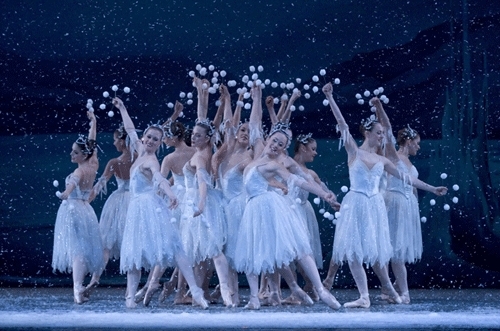
In a, well, nutshell: For us, the thrill was gone. (We wonder if it was ever there for the inane woman sitting next to us who was – get this – playing Solitaire on her iPhone during the first scene, until we – shocked and appalled – asked her kindly to please power down, shook our head in disbelief and finally…hissed, until she deigned to turn off the damn device. WTF!) BTB…back to the Joffrey: Sure, the 42 dancers – and some 70 children – gave it their all, with the live music (L.A. Opera orchestra under the baton of Joffrey music director Scott Speck) certainly a big help. So, too, were the costumes frothy, while the snow scene was requisitely, um, snowy. The addition of the National Children’s Chorus singing their offstage hearts out, provided an aural boost, as well.
But the troupe is now filled with very young dancers, most of whom we don’t know and are not yet mature artists. (We loved The Joffrey of yore, even the troupe from earlier in the decade, The Joffrey of Robert Altman’s underrated, The Company (2003, below), but whaddya gonna do. Time passes, dancers get injured, move on, age, with prima ballerinas not necessarily having to vie for Odette/Odile glory to play out the perennial dancer’s story. Okay, we just hadda get in our Black Swan coverage, so click here for that.)
We also didn’t care for the double casting: Fabrice Calmels and April Daly (seen on Saturday evening), were the prim and proper Mr. and Mrs. Stahlbaum, before becoming the pas de deuxing Snow Queen and Snow King (pity the backstage dressers). In truth, it seemed a bit Sybil-like to us, with Daly also dancing Pansy in the Waltz of the Flowers and Calmels serving as a support mechanism for his Arabian cuppa coffee.
Which brings us to Act II, still a showcase for dancers to strut their stuff in a series of divertissements featuring duets, quartets and all of those tutu-clad blossoms. The afore-mentioned Arabian, with Kara Zimmerman and Calmels (hello, again, at right), proved Cirque du Soleil-like, as Zimmerman executed one back-bend too many and a gasp-inducing six o’clock leg extension. She’s gorgeously thin, naturally, but the number felt forced and neo-cheesy. (Click here for our recent coverage of Cirque’s Iris.)
On the plus side, Victoria Jaiani and Temur Suluashvili brought elegance and verve to their grand pas as the SPF (Sugar Plum Fairy) and her Nutcracker Prince, though Suluashvili was a bit wobbly in his landings that were less buttery than margarine-like.
An aside: Any mention of a Sugar Plum Fairy now brings to mind the New York Times’ Alastair Macaulay, who last year wrote that NYCB’s Jenifer Ringer (right), looked like “she’d eaten one sugar plum too many.” That caused a veritable firestorm in the dance community, prompting us to write a piece for the LAT on body fascism; click here to read our take on that weighy topic.
Another plus: the towering Mother Ginger (puppeteer Francis Kane), with a slew of irrepressible kiddies bopping in and out from under that gigantic skirt. (Kermit Love was the creative designer for MG, the mice and Clara’s horse. Click here to read our Dance Teacher Magazine story on the fabulous Love, who also designed Sesame Street’s Big Bird.)
Oliver Smith’s sets have generally retained their holiday luster, though the rising magical Christmas tree somehow does not look as magical. Tchaikovsky’s score, on the other hand, never gets old (though we wish it wouldn’t blast from every conceivable source beginning in November, from the car wash and TV commercials to malls, both indoors and out). And speaking of Tchaikovsky, we’re still mourning the loss of the mega-talented director Ken Russell, who died last week (click here for our memoriam coverage), with one of his movies a biopic of Tchaikovsky, The Music Lovers, starring Richard Chamberlain.
But great art never dies, including The Nutcracker, the dance world’s biggest cash cow. So go find a production that suits you (and your budget), to see why it’s a holiday favorite. You might even find a prince to kiss, or at least to ogle. We certainly have!
P.S. This just in: Erstwhile dancer, now A-list choreographer/movie helmer Adam Shankman (Hairspray and the upcoming Rock of Ages), will be directing a new feature film version of The Nutcracker. The hitch: Shankman says there won’t be any pointe shoes – or much dancing at all – as he’s going back to the original Hoffmann story (The Nutcracker and the Mouse King) for this so-called “action-adventure-fairy tale.” As for Tchaikovsky’s music, who knows. That said, read about it here, but we at The Report aren’t exactly holding our breath, though if he cast the very princely Ryan Gosling…



 (Oh: Speaking of the Booker and slim volumes, Philip Roth snagged the prize in 2010 for his equally slight manuscript, Nemesis, much to the dismay of feminist judge Carmen Callil. That whack job of a decider claimed that Roth, whose books don’t stint on sex – had any recently, Callil – didn’t deserve to be shortlisted, much less win the prestigious award. Oy! We worship at the altar of Roth, so click here for our coverage on America’s greatest living writer.)