Opera, Opulence and Oysters: Hola, Valencia

Palau de les Arts Reina Sofia; or Santiago Calatrava’s Moby Dick of an Opera House

By Victoria Looseleaf

Who knew that Spain’s third largest city was the coolest hot spot on the Mediterranean. Truly, this seaside burg of some 800,000 folks located 185 miles South of Barcelona, is one of Europe’s best kept secrets. But blab about it I must, as I was truly overwhelmed by the people, the culture, the cuisine, the art, the architecture, and the sheer beauty of the city itself.

Vis a vis beauty, plazas are a good place to start (and because here in the States we have a dearth of them). So, after a harried arrival due to missing my connecting flight from New York to Valencia (from Los Angeles), and having to be rerouted through Paris only to arrive in Spain sans luggage (but who’s complaining…), I was, thankfully, part of a two-person junket with our own expert guides nearly every step of the journey. We began by taking in the octagonal bell tower, El Micalet at the Plaza de la Reine, also home to the splendid Valencia Cathedral.

Built on the site of a mosque and dedicated to the Virgin Mary, this mostly Gothic church houses a jaw-droppingly gorgeous alter, as well as important Renaissance frescoes and works by – who else but – El Greco and Goya. The big attraction, though, is the Holy Grail, claimed to be the chalice used by Christ at the Last Supper. Being a Jew, the religious significance is of far lesser importance to me than the epic quality of both the architecture and art.

The ornate glories of Baroque art. Photo by Victoria Looseleaf

I also loved the adjacent El Carmen quarter, rife with bars and small restaurants, as well as those daytime social hubs known as horchaterias, including Horchateria Santa Catalina. There I had my first taste of Valencia’s signature sweet drink – horchata – hello – made from local tiger nuts. Grreat!

As for signature foodstuffs on a more haute level, the modern wave of Spanish cooking was actually spawned in Spain by the world’s most famous chef, the Catalan molecular gastronomist Ferran Adria. While his three-star Michelin boite in Rosas, namely El Bulli, is scheduled to close in 2012 (and has been notoriously impossible to secure a reservation, as if mere mortals can even afford it…), Adria’s vision of anchovies in foam, powdered oysters, black garlic ravioli, game meat canapés and the like, has migrated globally. This means that tiny tastes (tapas) can also be found on nearly every corner in Valencia. One particular corner included Riff, Bernd Knoller’s chic eatery, where tables are curtained off and Herr Knoller comes around to chat up the cuisine.

Also offering personable service is Casa Montana, located in the old fishermen’s quarter, where treats include fresh mussels and glorious sardines (my grandfather loved sardine sandwiches, can you believe, making my fondness for the real deal – not tinned – a genetic one). And as for Valencian paella, well, this town is the mother lode. Call me a turista loca, but I dig La Pepica, an eatery on the Playa de la Malvarrosa. Now run by the founder’s grandson (the restaurant opened in 1898, with its habitués including Ernest Hemingway and Orson Welles), the paella, definitely me gusta. Sit outside, gaze at the broad expanse of sandy beach and muse on the notion that Visigoths, Arabs and Romans also left their cultural imprint on this intriguing city.

Sardines, brain food of the people. Photo by Victoria Looseleaf

Or don’t – muse on that – but keep drinking divine Spanish wines, before ducking into the 15th century Silk Exchange, which is adorned with lavish stonework, gargoyles and bawdy carvings. Also check out the Gothic buildings clustered around a walled courtyard across the street before heading into the Mercado Central. My idea of a Mercado –muy grande y fabuloso – it’s where locals shop for jamon, eels and, yes, Valencian oranges, all amazingly fresh and wonderful. And if you want a little aria with your artichokes, this is the market famous for opera singers bursting into song, notably excerpts from Verdi’s La Traviata.

Impromptu opera offerings in Valencia’s Mercado Central

But my ultimate fascination with Valencia – and what makes the hamlet simultaneously an old world and futuristic town – is the breathtaking new 86-acre City of Arts and Sciences. A culmination of 14 years’ work, most by native son, starchitect Santiago Calatrava, the edifices are a collection of white, organically contoured museums and theaters, including an eye-shaped planetarium, a science museum, botanical gardens and Europe’s largest marine park. And the crown jewel? The Palau de les Arts Reina Sofia, or the Calatrava Opera House.
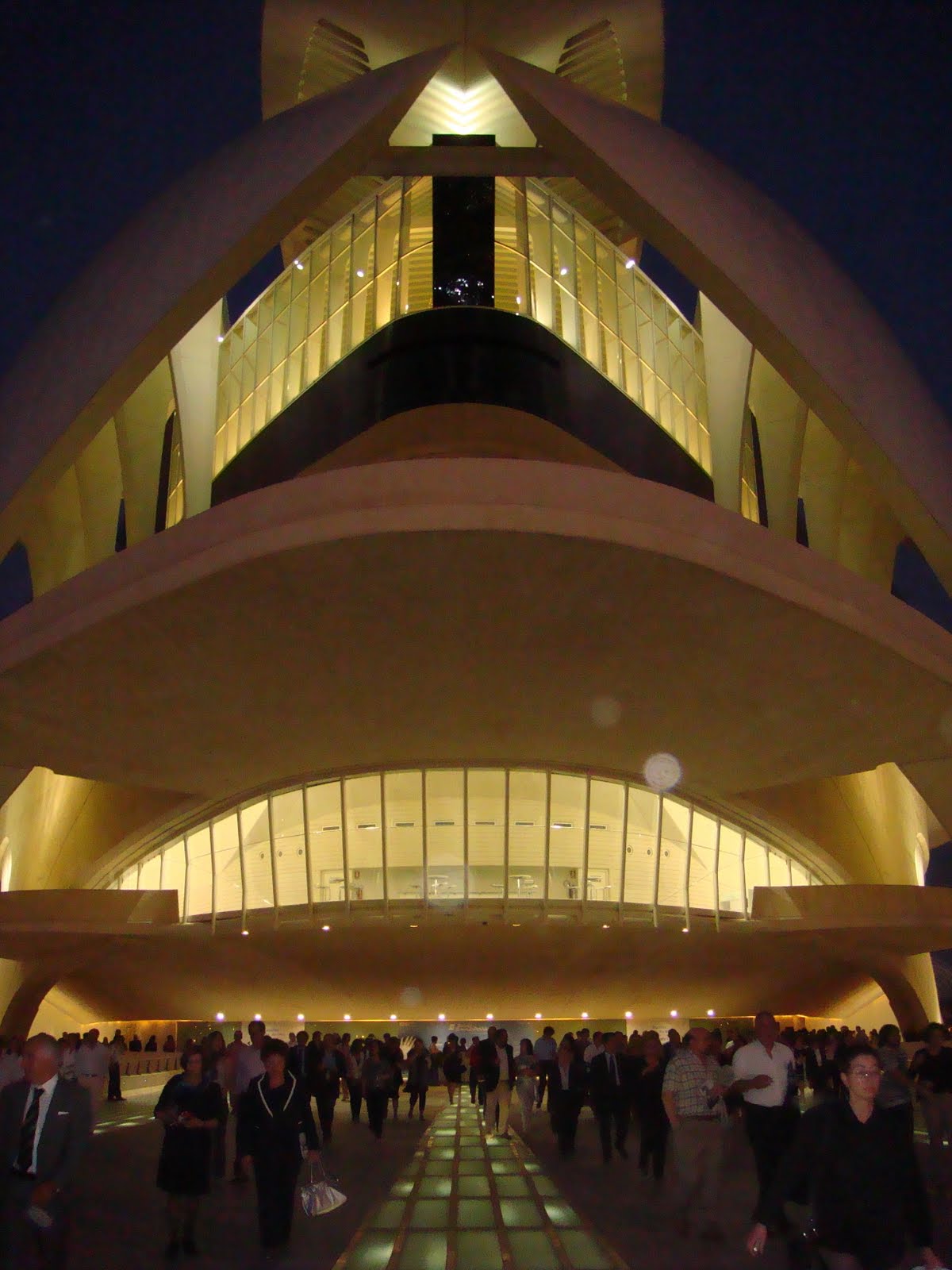
Moby Dick by night, as patrons emerge from the Calatrava Opera House. Photo by Victoria Looseleaf

Taking his cue from Valencia’s brilliant light (much like Van Gogh did from Arles), Calatrava fashioned white expanses and shimmering tiles as part of this surreal edifice that cost some 325 million Euros. Offsetting the cerulean sky and water, as well as mirroring nature with turquoise reflecting pools, the building also features a detached roof that seems to float like a feather in the balmy sea air.

Reigning supreme over the four acoustically marvelous theaters is the audacious artistic director Helga Schmidt, who has consistently programmed a cornucopia of forward-looking productions. Austrian-born Schmidt was the former artistic director of London’s Royal Opera House, and needless to say, she knows her way around the high art block. Indeed, Schmidt presented a Wagner Ring Cycle for the 21st Century (and Spain’s first), with staging by the avant-garde theater troupe La Fura dels Baus four years after the Moby Dick of a building opened in 2005. Schmidt, also a film fan, has attracted directing talents such as Milos Forman and Carlos Saura to build new audiences for opera. It also doesn’t hurt that classical music legend Lorin Maazel is the opera troupe’s music director and Zubin Mehta, whose 40-year affiliation with the Israel Philharmonic Orchestra is unprecedented, is its orchestra director.
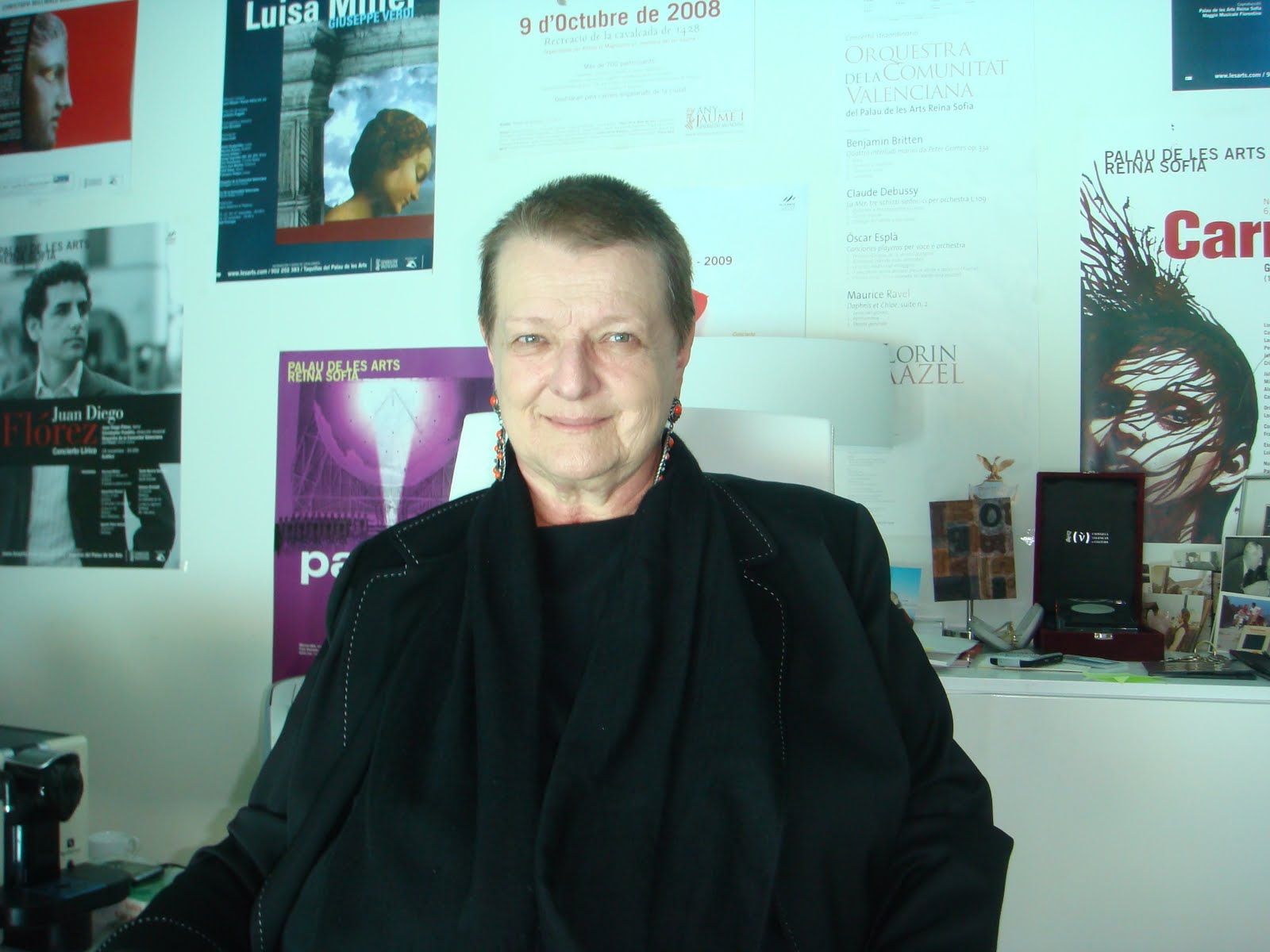
Artistic director Helga Schmidt, in her office at the Palau de les Arts. Photo by Victoria Looseleaf

The 2010-2011 season features David McVicar’s new take on Aida and Vincent Patterson’s production of Manon. Angelenos may remember Patterson’s 2007 uber-stylish world premiere with Anna Netrebko and Rolando Villazon (the Mexican tenor, alas, has since had a series of vocal problems, culminating in a prolonged hiatus). Patterson, who’s worked with Madonna, among others, featured Netrebko assuming Hollywood personas from Marilyn Monroe and Audrey Hepburn to Leslie Caron. In other words: Operatic kitsch killed. In a good way.

Other intriguing offerings will include Robert Lepage’s production of 1984, composed in 2001 by Lorin Maazel, as well as recitals and concerts: Our own Placido Domingo sings zarzuelas with Virginia Tola; and the hot Peruvian wunder-tenor, Juan Diego Florez (he of the High C’s who brought back the encore tradition at the Met in 2007 when he re-warbled, Ah! mes amis, from Donizetti’s Daughter of the Regiment), will also be strutting his stuff. Then, come late May, Mehta heads the month-long Mediterranean Festival, with various operas and concerts, including Mahler’s Symphony No. 3, on tap.

To quote Warren Beatty from Bonnie and Clyde: “Ain’t life grand!”

As for accommodations, take in the opera house from a fantastic 10th floor room at Hotel Barcelo, located across the way from the arts complex. You could even find yourself having a fashionable breakfast next to Maestro Mehta in the well-appointed dining room. Finally, with a large part of Valencia’s allure the sea (America’s Cup has recently been berthed there), nothing beats the five-star Las Arenas, where you can also catch a catamaran cruise under the moonlight. Emil Gergovski helms one of Mundo Marino’s spacious boats and serves a mean sangria. Viva Valencia!

Posted in BERND KOLLER, FERRAN ADRIA, HELGA SCHMIDT, HORCAHTERIA, LA PEPICA, LAS ARENAS, LORIN MAAZEL, PLACIDO DOMINGO, ROLANDO VILLAZON, SANTIAGO CALATRAVA, SPAIN, VALENCIA, VERDI, ZUBIN MEHTA | Comments Off on Opera, Opulence and Oysters: Hola, Valencia

Dancing Dreams: Pina Bausch Lives


The above clip is in German with French subtitles, but now Dancing Dreams is available on DVD with English subtitles. Hooray and danke schon!

By Victoria Looseleaf

A year before she died unexpectedly, in 2009, the incomparable dancer/choreographer Pina Bausch chose 40 teenagers to be part of her dance work, Contact Zone. The cool part was that these kids had never before heard of the beloved Bausch. During the 10 months the group worked – and through opening night – the teen terpsichores discovered not only Bausch’s genius, but their own bodies.

The one and only, Pina Bausch, Goddess of German Tanztheater

Now we can relive this fascinating journey in Dancing Dreams, a documentary directed by Anne Linsel and Rainer Hoffman. A testament to Bausch’s revolutionary work – and spirit – the film was shown earlier this year in various cities around the world, including Montpellier, France. Lucky moi: As I was covering that fabulous city’s dance festival for Dance Magazine, I was able to catch a showing of the documentary. And though it was – hello – in German (with French subtitles), I still got it, as dance is the art of non-verbal communication. But owning Dancing Dreams on DVD (First Run Features), is not only a treat, but a must – for Pina fans and Pina virgins – not least because this is the last celluloid appearance of the groundbreaking and brilliant, Pina Bausch.

Posted in ANNE LINSEL, DANCE MAGAZINE, MONTPELLIER DANCE FESTIVAL, PINA BAUSCH, RAINER HOFFMAN, TANZTHEATER WUPPERTAL | Comments Off on Dancing Dreams: Pina Bausch Lives

On Equal Footing – Or Not

Flying high at City Hall, Collage Dance Theatre-Style

By Victoria Looseleaf

Not wanting to gild the lily, squash the pumpkin or get all Looseleafean on you, here is my Los Angeles Times review of Collage Dance Theatre. Founded and directed by Heidi Duckler, the L.A.-based troupe is celebrating its 25th anniversary, so kudos to them. And, as it’s hard to sustain anything for a quarter of a century, especially a dance company (the most ethereal of art forms is particularly financially challenged here on the West Coast), the Leaf wishes them another 25 years!

Posted in COLLAGE DANCE THEATRE, HEIDI DUCKLER, LOS ANGELES CITY HALL | Comments Off on On Equal Footing – Or Not

Her Body Was Music: Isadora & Abraham on the Page


By Victoria Looseleaf

Life is a dance, and in a perfect world it should be artfully executed. Though I’m not talking 32 fouettes, we do need to be reminded of this from time to time, especially now, when the Twitterati have taken over, and life’s passages – i.e. status updates – are constantly reduced to 140 characters. Okay, so I’m guilty of Tweeting, but I’m also a lover of art with a capital ‘A,’ dance in all its glories, and real books, those bound things found on shelves that contain the printed word – or images – on actual paper.

For an escape into that world, then, and a return to a more civilized time, I recommend Modern Gestures – Abraham Walkowitz Draws Isadora Duncan Dancing, by Ann Cooper Albright. New from Wesleyan Press, this little gem captures the love affair that the Early Modernist painter Walkowitz (1878–1965) had with the mother of modern dance, Duncan (1877-1927), after meeting her in Rodin’s Paris studio in 1906. How fabulous is that! Theirs was not a literal affair, though with Duncan who can ever know, but one expressed in over 3,000 paintings, sketches and photographs Walkowitz created in order to capture the free-spirited dancer with brushes and lenses.

Isadora With the Strokes of a Pen. Drawing by Abraham Walkowitz.

Bringing these two giants together is Albright, who delivers fresh insight into Duncan’s gestural movement vocabulary and Walkowitz’ divine art with her astute writing. Tackling an array of themes, Cooper breathes dreamy life into these historical figures. Included are the pair’s role in the broader cultural context of early modern dance (talk about a scintillating dialogue between motion and space), and the ways in which Walkowitz uses paint to capture a single movement, eventually creating kinetic narratives of Duncan’s steps.

Writer Gertrude Stein also weighs in, thanks to Albright. On similar artistic wavelengths, Stein, who befriended Picasso and crew, and, with her lover, Alice B. Toklas made hash brownies famous, also knew Duncan. Here several of Stein’s prose portraits complement Walkowitz’ drawings. In essence: This is beauty and truth at their most simplistic. Not exactly a flipbook, or what some might seek in Muybridge’s famous horse photography, this work speaks boldly in spare colors that, nevertheless, sweep the viewer away on waves of profound grace. Using the power of art to seduce, this tiny tome takes us back to beauty.

Posted in ABRAHAM WALKOWITZ, ANN COOPER ALBRIGHT, GERTRUDE STEIN, ISADORA DUNCAN, PICASSO, WESLEYAN PRESS | Comments Off on Her Body Was Music: Isadora & Abraham on the Page

Three for the Road

The prolific guitarist/composer 
Howard Fishman.

By Mary Lyn Maiscott

Jazzy singer-songwriter Howard Fishman—who as a guitarist has played with such luminaries as Nellie McKay—recently released not one, not two, but three CDs of his songs. “I kind of lost my mind” was his explanation of the unusual outpouring to the filmmaker Marie Le Claire, who has been documenting the making of the trilogy. Though held together by his affecting, Lou-Reedish-I’m-not-quite-singing vocals and his superb musicality (as well as, as fellow blogger Robert Rosen commented, “a good vibe”), the three works are nonetheless quite different from each other: Better Get Right is Howard’s “love letter to New Orleans,” as he puts it on his website, with the sounds of his Biting Fish Brass Band reflecting that city’s sometimes raucous street jams; No Further Instructions, perhaps the most intriguing, turns a trip through Romania with his friend the photojournalist Michael Benanav into a folkish (in the pure sense) song cycle, complete with violins and accordion (and spoons?); and The World Will Be Different involves, fittingly, a different kind of journey, an interior, thoughtful one after a romantic breakup, with, primarily, a four-piece combo. (Bonus for New Yorker subscribers: the lyric “I’ve been on a roll/Even my stack of New Yorkers is under control.” If Howard can do it, maybe I can too!)

What does one do after delivering such a creative triptych? If you’re Howard—who made some noise a few years ago by recording his own interpretation of Dylan’s Basement Tapes—you play them all live, successively over three nights, November 4–6, at Abrons Art Center in NYC. Howard says he expects to find these performances “both emotionally draining and positively cathartic.” Of the final night’s songs, his reliving of The World Will Be Different’s stormy love affair, he adds, “I don’t think I’ll ever want to play them all together again.” Take the ride with him, while you can!

Posted in Better Get Right, Howard Fishman, Marie Le Claire, Nellie McKay, No Further Instructions, The World Will Be Different | Comments Off on Three for the Road

Roth Rules

Ink Makes the Man. Philip Roth Makes Ink.

By Victoria Looseleaf

Although I’ve been the recipient of fan letters, I had never written one, until, that is, I scribbled one to Philip Roth. This was after I read I Married a Communist (the second of his brilliant 1990’s trilogy, American Pastoral being the first which also won the Pulitzer Prize), in which one of his characters played the harp. Well, Roth never responded. Did his publisher even forward the letter to the near-recluse who lives in Connecticut? Did I actually expect he would? Would this leave a sour Rothian taste in my mouth? Would I care?

I dunno the answer to the first, I hoped the answer to the second would be affirmative and no, these were not reasons enough to go all negative on Roth, but that I bring it up now must mean I still care. Oh, well: Not even the lunacy of casting Nicole Kidman in 2003’s The Human Stain (like anyone would ever believe her playing a maid), or the folly that was Elegy, the 2008 flick based on Roth’s The Dying Animal (from 2001), could put me off our country’s greatest living novelist.

But, beginning in 2006, with the publication of his so-called short novels – Everyman, Indignation and, from last year, The Humbling – I became less enamored with the writer’s obsessions with aging, sex and the like. Indeed, I didn’t even check out The Humbling (so sue me, Philip, but your publisher, Houghton Mifflin, couldn’t be bothered to send a review copy, and I took that kind of personally).

Which brings me to my ecstatic return to Roth, now 77, and the final work in the quartet. Nemesis is his 31st novel and it feels great to be back on the Roth train, that East Coast Jewish trip that speaks for/to so many of us. Oh, yes, I see now where you were going, as Nemesis, set in Newark, N.J. during the summer of 1944, tackles the eye of the hurricane that was then the polio virus, and actually sums up the themes of the entire quartet: How the consequences of our actions – our choices – make us who we are and define us with regards to all of the existential stuff – death, grief, regrets, and oy – the unavoidable tempis fugit fear/doom/acceptance thing that never ceases to weigh on us.

A single action can change the course of many lives as easily as it can the course of one. My own father had been struck with polio as a young boy in Cleveland in the 1930’s – but he was lucky. Weirdly, he came down with the disease in the winter (it generally hit in the summer), and having a mild case for only six weeks, it then mysteriously disappeared. Would my father have gone to Ohio State and met and married my mother if he still had polio? Does he think about these kinds of things? Does my mother? Does anyone?

Yeah, Roth not only thinks about them, he delivers the goods in eloquent prose. How his 23-year old protagonist, the playground director Eugene Bucky Cantor, responds to the polio epidemic, makes up Nemesis’ 280 brilliant pages. The book is so good that now I’m going back to The Humbling, because Philip Roth continues to astonish, move, draw tears and laughter in equal degrees and, finally, ask all the big questions. He may not have all the answers, but that’s why we have HBO…(only kidding). Roth’s the man. Talk about a dude abiding, this one decidedly does. So, if you’re out there, sir, and happen to come across my musings, you know where to find me.

Note: I’m not alone in my reverence for Roth. To quote Scott Raab from his recent Esquire interview with the author: “Read the books. The Newark wiseacre spitting out novels like a bachelor-party stripper firing Ping—Pong balls out of her snatch is seventy-seven years old now. Behold a master, treasure his work, and shut the fuck up. Just read the books.”

Posted in HOUGHTON MIFFLIN, NEMESIS, OHIO STATE UNIVERSITY, Philip Roth | Comments Off on Roth Rules

Death in a Strip Mall

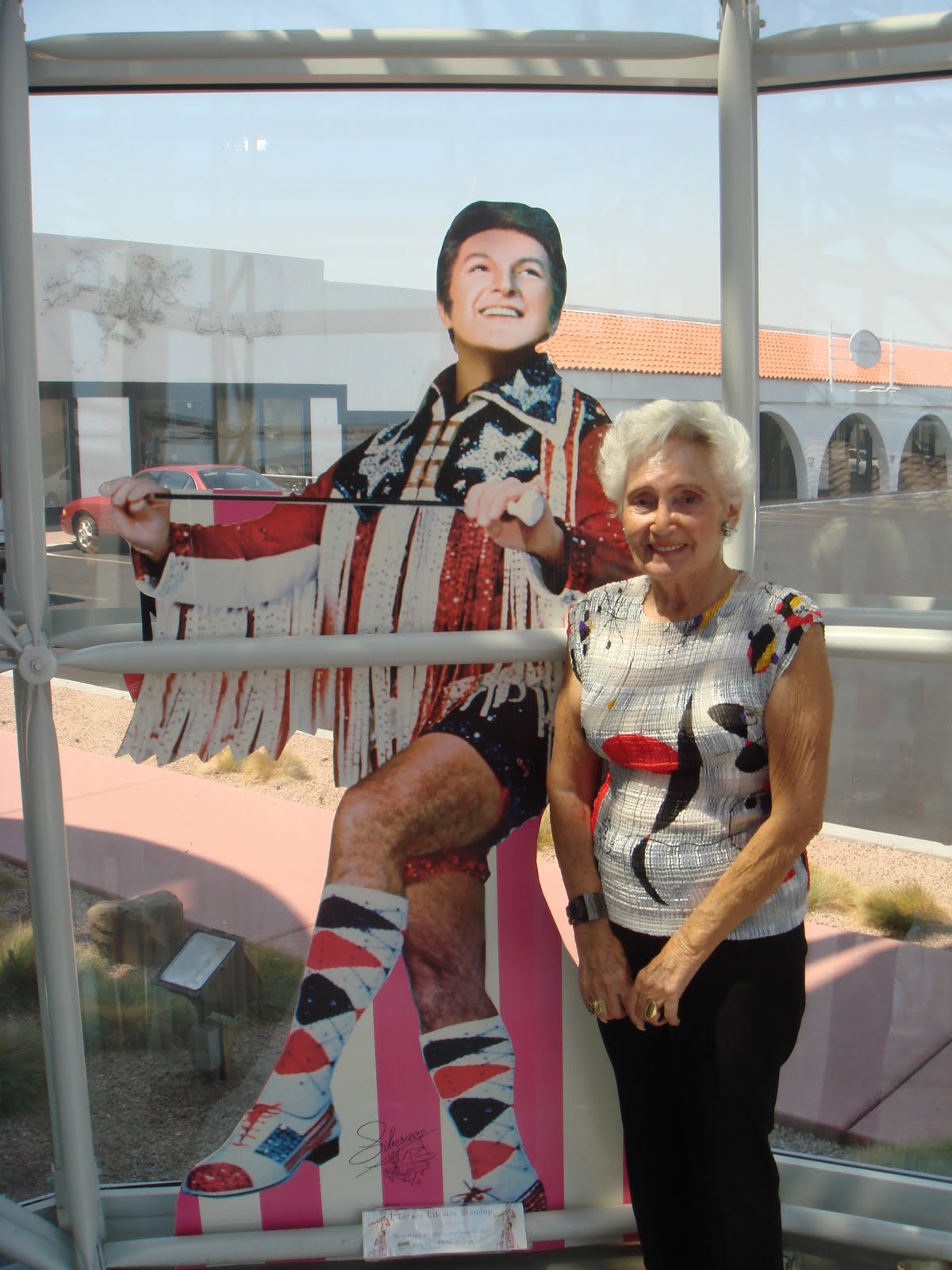
Mama Looseleaf and a Cardboard Lee (Liberace). Photo by the author

By Victoria Looseleaf

The original King of Bling – that ivory-tinkling, Rolls Royce-loving, AIDS-denying entertainer, Liberace – is no longer in posthumous residence in a Las Vegas strip mall. In other words, the Liberace Museum, which was opened by the performer born Wladziu Valentino Liberace in 1979, and in its heyday welcomed 450,000 tourists a year, has now become another casualty of the Recession/Depression.

Or is it the fact that those enamored of the shameless self-promoter are themselves dying off? (Full disclosure: Covering five Vegas Cirque du Soleil shows in 2007, I visited the Tropicana Avenue repository with my mother, buying her a keychain, which, by the way, broke shortly thereafter. Click here to read my latest Cirque reportage for Dance Magazine, a review of Iris, and click here to read our multi-Cirque coverage, Cirque du Shekels.)

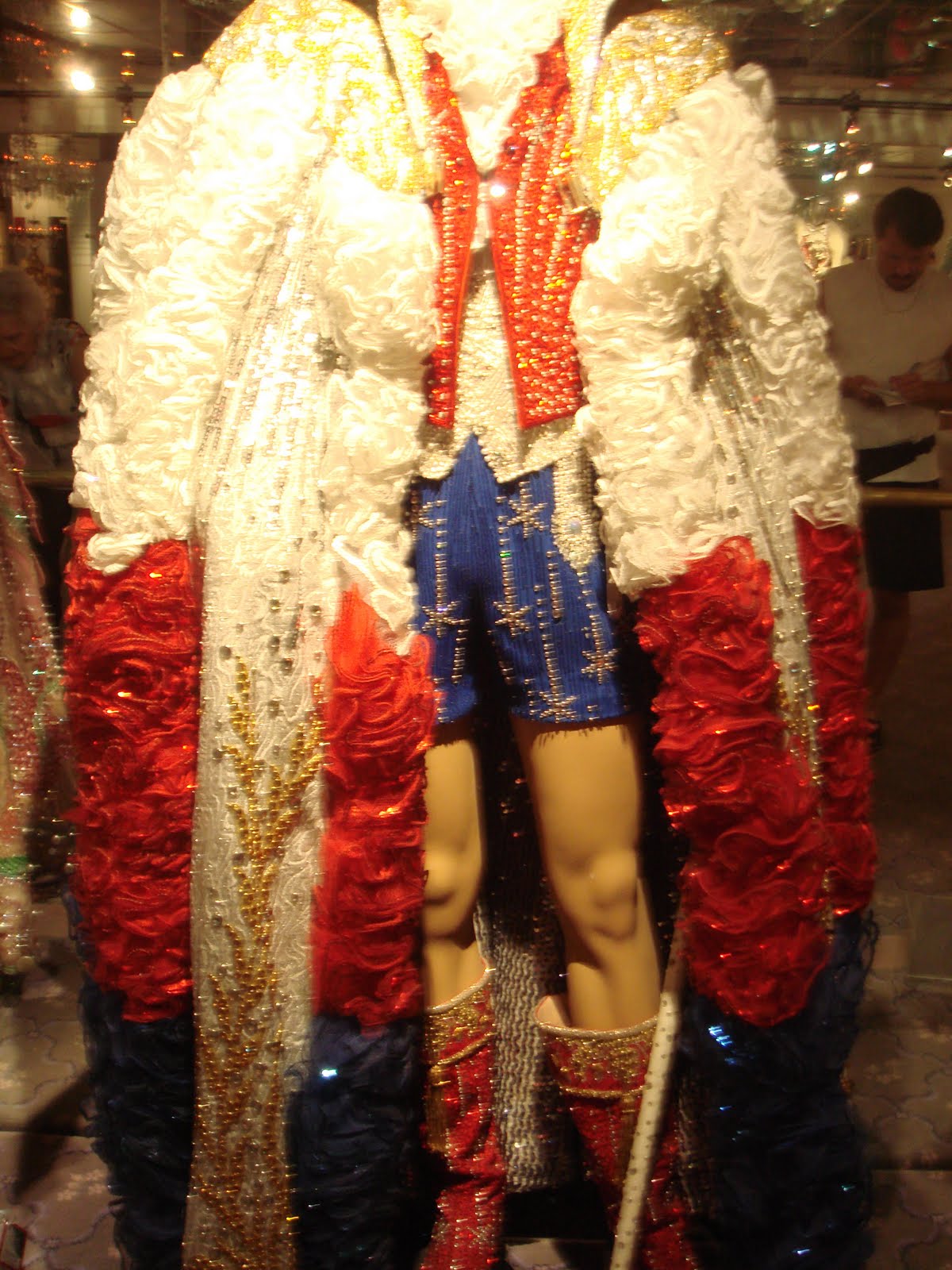
Patriotic Hot Pants: Eat Your Heart Out Lady Gaga. Photo by Victoria Looseleaf

Whatever. While Liberace, the, er, man, died in 1987 at age 67, his legacy loomed large at the 16,000-square foot space. Home to a 1962 mirror-covered Phantom V Landau Rolls-Royce, more candelabras than can be found at Versailles and such outré outfits as red, white and blue hot pants (worn with knee-high boots at Liberace’s Radio City Music Hall gig), the glory days of the museum are, indeed, no more. The red neon piano on the roof has come down, and the mall, as vacant as Meg Whitman’s smile, will never be the same.

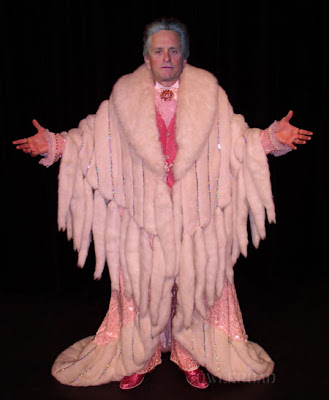
Think Pink. Michael Douglas, as Liberace, in a role he was born to play.

As for all that ridiculously garish stuff (what else can you call a rhinestone-encrusted piano), some of the collection will be displayed in a traveling exhibition. But Graceland the showplace was not. It’s official: Michael Douglas is slated to play Liberace in a biopic directed by Steven Soderbergh. Cast as the flamboyant entertainer’s former chauffer/lover, Scott Thorson, who sued Mr. Showmanship for $113 million for palimony, is none other than…Matt Damon. It’s called Behind the Candelabra, it’s for HBO, and Oscar talk has already begun, fersure. (Click here to read more about this fascinating tale.) Until then, I think I’ll put on Liberace’s rendition – certainly the definitive one – of Beer Barrel Polka.

Posted in AIDS, LAS VEGAS, LIBERACE, MATT DAMON, Michael Douglas, STEVEN SODERBERGH | Comments Off on Death in a Strip Mall

Blond Harmonies and a Timeless Troubadour

Christopher Paul Stelling

By Mary Lyn Maiscott

Caught a couple of promising acts on Saturday, the last day of this year’s CMJ festival, both of them playing at Rockwood Music Hall on the Lower East Side—a marvel of a tiny space put to excellent use. (Drew the sound guy was up the built-in ladder sitting with his legs dangling from the sound booth.)

With his been-around-the-block guitar inscribed with various symbols (“CPS” being the easiest to figure out), his unruly hair in a modified ponytail, and his blue eyes at times almost alarming in their intensity, Christopher Paul Stelling comes across as a kind of neo-Testament prophet. His imagery-rich songs, involving suicide, murder, heaven, hell, ocean depths, bayous, and of course lost love, hearken back to 18th-century Scottish ballads (“Barbara Allen,” anyone?) even as they tap into the perpetual human condition.

After his gripping concert—disarmingly, in between the Gothic-tinged songs he commented on the quality of his Bloody Mary and, in an oblique comment on his strenuous performance (he uses his booted foot as percussion), informed us that his mother was an aerobics instructor—Chris told me that he’d like to go to Scotland, partly because, he said, they sing there without amplification. “I hope we’re heading toward more sincerity, less production,” he added. (No Auto-Tune for this guy.) Onstage he did occasionally stray from the mic, with no sound diminishment that I could detect.

Check out a video of Chris in action; I haven’t even mentioned his extraordinary finger-picking stylings, by turns muscular, breakneck, and celestial (and at times all three).

Delta Rae

In their first, a cappella song, the North Carolina group Delta Rae also stomped the beat—is this a trend? Composed of the baby-blond siblings Ian (who looks like Woody Harrelson), Eric, and Brittany Hölljes and their childhood friend Elizabeth Hopkins (they were smart to bring in a brunette; it cuts the sunniness factor), the band specializes in close harmonies. While a couple of their original songs were pretty good—such as “Ooh Caroline,” the subject of which they claimed materialized, uninvited, at one of their NYC concerts as they were performing the song—the four really showed their talents in the two covers they did: a revved-up “California Dreamin’” (just as I was thinking that Brittany Hölljes reminded me of Michelle Phillips) and their “model” (as Brittany told us) Fleetwood Mac’s “The Chain,” in a thrilling rendition. Though it doesn’t come across quite as well recorded in, we’re told, a bathroom, they did upload that one to YouTube.

Posted in Christopher Paul Stelling, CMJ, Delta Rae | Comments Off on Blond Harmonies and a Timeless Troubadour

High Art, Hot Sex and A Nose Job

By Victoria Looseleaf

Not Far From the Madding Crowd. Director Stephen Frears takes in the love at Cannes for his latest film, Tamara Drewe.

Stephen Frears is a class act. Though the director of The Grifters, Dangerous Liaisons and The Queen, to name but a few of his fabulous flicks, was jet-lagged and noticeably fatigued after having done a series of back-to-back press interviews for his new film, Tamara Drewe, the amiable Brit didn’t mince words. Herewith, then, are three mini-chats with the inimitable Mr. Frears and your intrepid reporter for KUSC-FM.

Posted in DOMINIC COOPER, GEMMA ARTERTON, KUSC-FM RADIO, STEPHEN FREARS, TAMARA DREWE | Comments Off on High Art, Hot Sex and A Nose Job

Booknotes, Footnotes and Loose’s Notes

Writer, Thinker, Mensch: David Grossman. Photo by Victoria Looseleaf.
By Victoria Looseleaf

One of Israel’s finest writers, David Grossman, was in the City of Angels the other night to talk about, read from and – sell and sign – his latest work, To the End of the Land. Recently translated by Jessica Cohen and released by Knopf, the book has been the recipient of more great press than Michelle Obama (her all-girl vacation to Spain aside). In this case, the hype is true, with an in-depth New Yorker profile also offering plenty of insight into Grossman the man and author.

Having been to Israel twice in the last 18 months, I fell in love with my spiritual homeland, and am beseeching those interested in fabulous contemporary Israeli literature to get a copy of Grossman’s novel. NOW. It’s a fascinating read, each page a gift. To the End of the Land plumbs the universal themes of love and loss, as well as offering astute views on the state of Israel today, its ongoing conflicts and the quest for peace.

Alas, while peace may seem elusive, books are tangible and this fall has given us an array of wonderful ones: I just finished Sjeng Scheijen’s glorious bio, Serge Diaghilev, A Life (Oxford Press), another translation, in this case from the Dutch. As a professor of dance history – and a dance critic for publications including the Los Angeles Times and Dance Magazine – I love the Ballets Russes period (1909-1929).

It was then that Diaghilev brought together the greatest choreographers, composers, artists, costumers and dancers of the 20th century – hello, Sacre du Printemps – with Igor Stravinsky’s score to Vaslav Nijinsky’s outre choreography causing a riot at its 1913 Paris premiere. I was also intrigued to discover Scheijen’s revelation debunking the notion that Nijinsky was seduced by Diaghilev. He writes, instead, that one of the world’s greatest dancers pursued the impresario. In addition, there are loads of luscious pictures and heretofore unpublished letters, all giving a genuine feel for the era.

Igor Stravinsky’s grave at San Michele, Venice. Photo by Victoria Looseleaf.

Diaghilev was also superstitious, especially fearing water. When a gypsy told him that he would die on or near same, this actually came to pass, with Diaghilev passing away in Venice in 1929. His colleague, the incomparable composer Igor Stravinsky, is also buried in the small island cemetery of San Michele (next to his beloved wife Vera). When in Venice two years ago, I took a vaporetto to this lovely burial site, where, curiously enough, the poet Ezra Pound also rests for eternity, as does the Russian-born poet and essayist Joseph Brodsky.

But back to the tomes: On the subject of dance, I must also give props to Jennifer Homans’ Apollo’s Angels: A History of Ballet (Random House), a scholarly work that reads like a novel. Homans, a former dancer, captures the most ethereal of art forms in what The New Republic’s Leon Wieseltier calls, “an enlightenment…a remarkable feat of scholarship and sensibility.” (But don’t get me started on Homans’ recent essay mourning the death of ballet. The art form is alive and kicking, though its high ticket prices and built-in snob factor, alas, are still part of this rarefied world.)

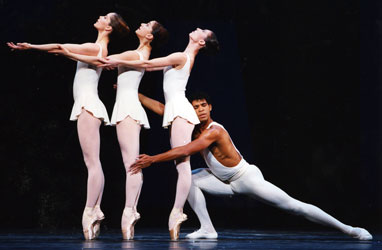
The Royal Ballet’s Apollo, choreographed by George Balanchine, featuring Carlos Acosta.

Also on the bio front – and because John Cage was big in the dance world as well as the musical sphere (he was the partner, both professionally and personally, of Merce Cunningham) – is Begin Again, A Biography of John Cage, by Kenneth Silverman (Knopf). Cage is the genius behind 1952’s groundbreaking work, 4’33″. This opus consists of the performer sitting at the piano for the appointed time of 4’33”, without playing a note. A radical notion then, perhaps even more radical now. (An aside: On both my albums, Harpnosis and Beyond Harpnosis, I play Cage’s In a Landscape, having asked him for the rights. Talk about an angel!) That said, check out one of the last century’s true originals, John Cage.

Finally: Jonathan Franzen’s brilliant novel, Freedom (Farrar, Straus and Giroux) is also worthy of its bestseller status. A long time coming – The Corrections was published nine years ago – Freedom was worth the wait. So, pull yourself away from your flat screens (I gotta admit, though, Boardwalk Empire rocks), turn off your iPhones and start reading a book, physically, one with real paper and beautiful print. Talk about a radical notion!

Posted in BOARDWALK EMPIRE, DAVID GROSSMAN, DIAGHILEV, HARPNOSIS, ISRAEL, JENNIFER HOUMAN, JOHN CAGE, JONATHAN FRANZEN | Comments Off on Booknotes, Footnotes and Loose’s Notes